Showing posts with label west-africa. Show all posts

Tuesday, March 11, 2014

Stuff I've Made: Quilts with West African Wax Prints

African Market quilt.
I was trying to show a colleague my West African wax print quilts that I made shortly after our trip to Burkina Faso, Togo, Ghana & Cote d'Ivoire in 2006.  And realized that I have mentioned them but never put them up on this site.  The Roommate had 2 snow days last week (I had none!), so he took some photos for me. Thanks, Honey! 

So, we did our last big backpacking/overland trip for 5 weeks through West Africa.  Last because we're getting pretty old to be lugging backpacks around and sitting on buses for hours, staying in places with shared baths, etc.  We've done that all over the world, partly to stretch our travel & souvenir-buying $$, but also because riding buses (not renting a car & driver) and staying in hostels is a great way to see how the local people live. We don't cover as much ground and certainly travel inefficiently, but on the other hand it's a great way to find out what's happening, plus watch some wonderful Nigerian movies on the bus, and get off and do bird-watching every time the bus driver takes yet another unscheduled break. We are usually the only non-locals on the bus, always of great interest and high entertainment value, plus people are generally quite friendly and curious about who we are and what we are doing there.  
Reverse of African Fabric Shop.

We knew we wanted to buy as much kente, kuba, bogolon textiles, and wax print fabric as we could carry on the plane (about 40 lbs/each). So we took old clothes and shoes that we left behind, and just stuffed our backpacks! We used a scale in a little neighborhood market to check & were thrilled when we got to the airport & checked in with 79 lbs!  

Reverse of African Market quilt.
We've spent time in markets all over the world (we love them, in fact, and go out of our way to be in town on market day), but found them to be so crowded that you spent the whole time worrying about being pick-pocketed.  Also, they are HUGE, so it's really hard to find what you want; i.e., the textile stores!  When we finally found the fabric section in the Accra market, we discovered that the prices weren't that much better, and the selection wasn't any different in the less crowded, well-organized shops a little bit out from the city center.  

African Fabric Shop.
Speaking of fabric shops...they were wonderful. (A few photos here.) Clean, organized, & often with marked prices--a real luxury.  So the second quilt I made is called African Fabric Shop.  I used pieces of all 44 fabrics I bought, (as I did with the Market quilt), but tried to make them a bit more orderly.  Both of these quilts are smaller (3' x 4' or so), and we use them all the time in the sun room when we're reading or watching a movie.  Bella also loves them, which is really all we care about.

The last picture, below, is to show you the great machine-quilting my friend Mala Ramakrishnan, of Classic Quilts Dubai did.  Mala is an amazing quilter & a true artist, so I always felt safe giving her my quilts & saying, "Whatever you think will look best."  Both are quilted with the same pattern, to make them a matched set, along with the same fabric selections being used in both. 


Friday, July 12, 2013

Western Africa Shirt?! Finished!! Simplicity 6693

I doubt I'm the first person to think of this, but I am so pleased anyway...a Western shirt for the Roommate, made with West African fabric!  *smirk* 

So you saw some previews in the last post, but here's the whole chimichanga!  With the supermodel showing how it's done...

I took lots of pictures for 2 reasons: 1) I'm extremely proud of it and 2) because I wasn't the one having my picture taken!  I do not love being on the other side of the camera.  

This first picture shows the Roommate wearing a BIG smile (it may not look like it to you, but believe me, after 30+ years, I can tell when he's happy--even if you can't!).  I think he likes it.

It was actually fairly easy.  I have really always thought that making men's clothing would be the hardest thing possible, but after 4 pairs of underpants and 2 shirts, I'm feeling less intimidated.  So much so that I'm going to repair some of his Mohammed-made suits which are mostly in good shape, but the lining needs some repair and the buttons need replacing.  I won't be making any ties or suits anytime soon, though.  

I'm starting to realize that perhaps it's the fabric & fitting that makes things difficult, and if you work with cotton and sew for men (who don't need so much fitting), it's not that difficult after all!  

The second photo, on the left, shows the medallion, which appeared by accident in the fabric we bought in Cote d'Ivoire.  I think it looks great & is a super substitute for the embroidery recommended on the original 1974 pattern.  

I was thinking about a Western (African) shirt after seeing Cracker & Camper van Beethoven a few months ago at the State Theatre...then I figured out where to get the pattern from Zoe's post about the shirt she made for her husband.  

I really love how the big print & the little print work together, too.  

Some of the stuff I learned while making this pattern...

First, the collar band.  I was so confused at first I tried to just sew the collar on, the way I do with my clothes.  But then I went and looked at some of the Mohammed-made shirts the Roommate has & figured it out quickly. So I took it off & did it again.  (I was glad to see even Tasia has do-overs!)

You can see the collar band up close in the 2 photos below:


And second, how to put on pearlized snaps.  Which you don't need a special tool for; the instructions on the back of the Dritz snaps are very good. And very good for working out your frustrations! 


The photo above shows the button placket detail, with the snaps, and also with my extra attention to detail.  I have mentioned before how often in West Africa we noticed they use the fabric right up to the selvage.  Why not? It saves hemming & you get a bit more additional fabric.  

The fabric I used had great selvages on both the large & the small prints. You can see how I incorporated it into the placket, which I think looks pretty darn cool! That same selvage also worked to line the edge of the slash for the cuffs.  You can see that in the detail to the right.
Pocket with snap!

The pocket was another area where I used the selvage.  Here's the London Wax Prints & the RB mark which show on the pocket upside down.  But that way the Roommate can read it!  I did not put the snaps on the pockets...couldn't quite decide if it needed them; I may still do that.  


A few more pics below and I'll stop.  I hope this inspires you to try something (somethings) new, too!

And I think the appropriate music for this particular episode?  Euro-Trash Girl by Cracker!


Someone is on summer vacation & hasn't been
near the razor much!

Friday, July 5, 2013

Reverse-Thinking (aka Planning)

You'll see from my posts about batik and ikat that one thing that really impresses me about these techniques is the planning required to think "backwards."  By which I mean starting out with the lighter color, then going darker & darker to create a multi-colored piece of art.

As I've mentioned before, ikat & batik are the 2D/textile versions of relief carving techniques for wood or marble...both of which completely mess with my brain.

What it comes down to is planning.  Which I think I'm pretty good at, but when sewing I often find that maybe I'm not as good as I think I am!

For example, the Western shirt I'm making for the Roommate, Simplicity 6693, which I found at Etsy after being inspired by Zoe's shirt for Paddy.  I decided to use this wax print we got in Cote d'Ivoire for the contrasting yoke & cuffs, because though it's amazing, it's a huge print, which I can't get anywhere near my body--the hugeness might overcome us all--and there's not really enough to do much with, other than pillows.  

(Maybe I mentioned that most fabric in West Africa is sold in 2 yard or 6 yard pieces?  Because 2 yards are needed for a pagne, from which you can make a skirt, a top, a headdress, or a carrying cloth for your baby.  So that's why I didn't buy a whole lot of fabric...I was going for variety so bought many 2-yard pieces, or smaller scraps, rather than a few 6 yard pieces.  We brought home 80 pounds of textiles, leaving almost everything else we had taken behind, so I wasn't going to waste space or weight on big batches of a few samples.)

Anyway, so, without really thinking I cut out the contrasting yoke & cuffs.  Then, when I went to sew the yoke onto the shirt, I saw this:  

Without noticing, I had a huge medallion right in the middle of the contrasting yoke.  Except it wasn't exactly right in the middle, darn it!  It was about 9pm, so I decided I'd take a look in the morning.  

This often happens when I make a mistake.  I walk away from it, especially if it's getting close to bedtime, because I often find I just make even more mistakes, which require more ripping out & re-sewing.  I also very often have to talk myself into the ripping out/re-sewing part!  I am essentially quite a lazy person & avoid do-overs whenever possible.  I'm much more of a make-it-work and hope no one notices girl.  

So I get up Saturday morning, take a look at the shirt, and though I know that the Roommate wouldn't notice, and probably most people wouldn't either, the amazing medallion will be most effective if I un-sew/re-cut/re-sew.  And really, I brought the darned fabric all the way from Ivory Coast...why not use it well?!  And after yoga...

Here's the new yoke, after the re-cutting.  I think you'll agree that it's going to look great...and sort of goes along with the suggested embroidery featured on the pattern's cover.  

My least-favorite, but most-used tool, along with a preview
of the main fabric for the Western shirt.


Wednesday, June 20, 2012

McCall's free pattern from Post Cereal; in W. African fabric

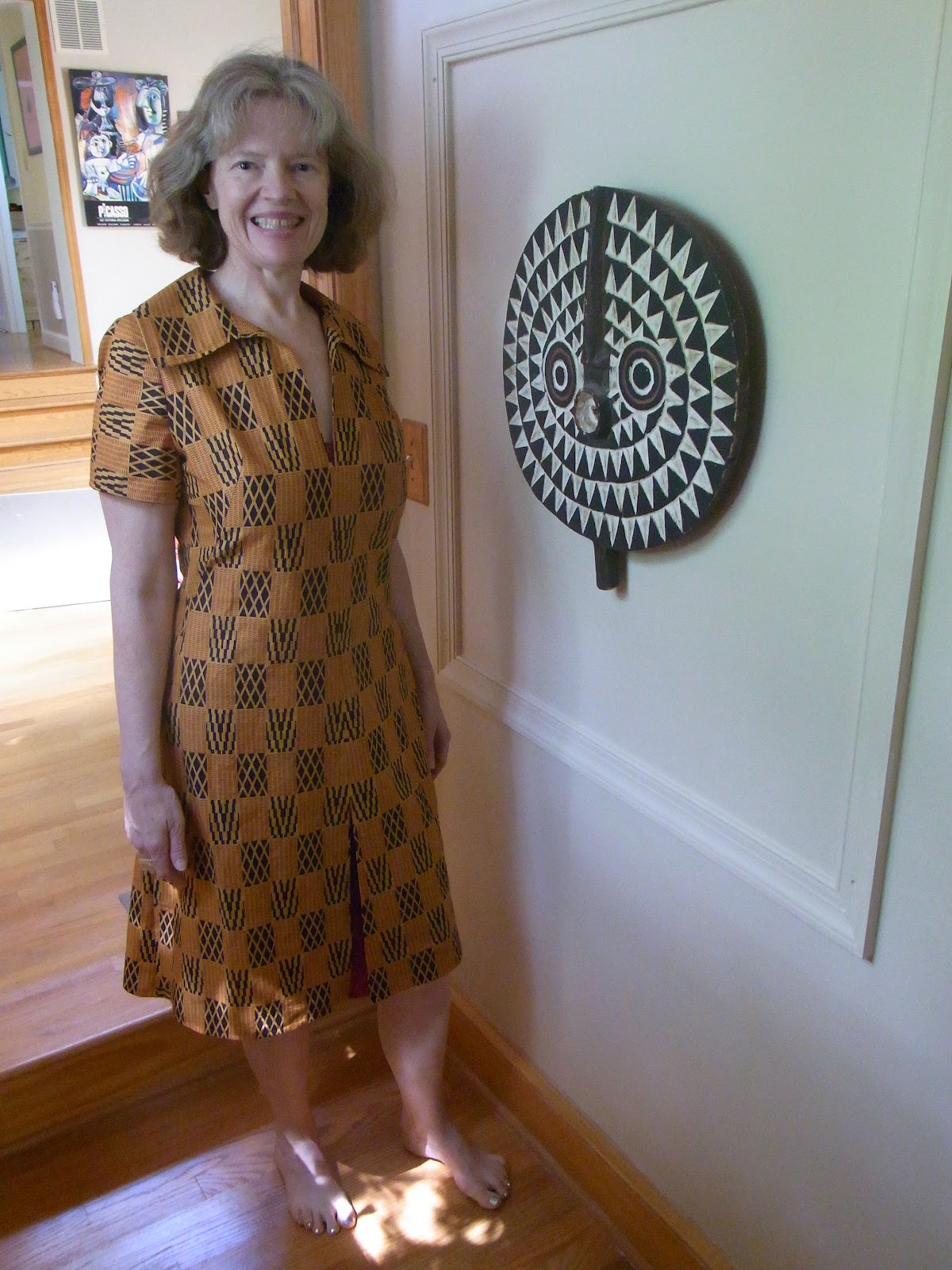
Here's the McCall's pounds-thinner pattern that my mom sent a while back.  I mentioned it in my last post, about vintage sewing patterns.  And I've made it up in some of the fabric I got in West Africa, probably Ghana or Burkina Faso.  It's supposed to look like strip-woven Kente (typical of Ghana); go to that page to see the real thing (strips woven on a narrow loom, then sewn together to form a delightful pattern).
The underside of the collar.

This is fairly cheap cotton, very thin & not at all drapy, and I was worrying about wearing it without a slip.  Then I remembered I had a pretty burgundy silk slip from Wintersilks, which almost matched the terracotta red in the cotton.  When I tried on the dress, almost done, yesterday, I had to take off 2.5" from the slip.  So I did that, and re-hemmed the slip.

Almost nothing left over!
I ended up using all that extra silk, though, because I barely had enough fabric to make the dress and there is nothing left over. I had to cut the length of the dress from selvage to selvage; there wasn't enough to cut it the normal way!  (Which meant I couldn't play with the length & proportions much--I just had the fabric width.)

I used the silk I cut off to hem the bottom & the sleeves.  There was so little fabric, I couldn't get the underside of the collar out of the kente print and had to use other West African wax print fabric.

Take it to the selvage!
I really made an effort to show the selvage of the fabric because we noticed that a lot in West Africa.  Rather than hemming, clothes are cut so the selvage is the hem.  However, this dress has quite a curved hem, so I ended up losing more than I wanted.

I will make this one again.  I love its cool look and big collar.  I will definitely add a bit in the middle so that the french darts are lower, and I'd probably make the overall length a bit longer, too.  Also, it needs a sway back adjustment (not much)...


BTW, it's got to be the best looking zipper I've ever installed!  I'll give a shout-out to Allison @ Bits of Thread in DC for her expert tutelage. 

Friday, June 1, 2012

Straight from Mali!

A friend here at work, (she's one of our international students), is from Mali.  She asked her sister to have something made for me...and I thought you'd like to see it.  Her sister has never met me (never even seen me) and I can't believe how well this jacket fits!  I believe it's quite flattering, too, and am thinking I might need similar coatdresses to wear over skirts.  See what you think! 

I wore it over a lace skirt I have, along with a peach-colored top & my amber.  (This is definitely one of the worst photos my iphone has ever taken--light is an issue in the library right now.) 

Thank you, Nema!

Saturday, February 4, 2012

A D I N K R A ! - Fabric stamping from Ghana

I've mentioned before how we collect not only textiles, but also tools used to make those textiles.  So here are some Adinkra stamps along with a piece of Adinkra, all of which we got in Ghana. (Our travel photos from that trip are here.)  And here's a video of someone using the stamps.

The stamps are carved from calabash gourds & you can see on the 2nd example that they are curved.  You'll notice in the video that the printers have to "rock" the stamps a bit to get the complete design to stamp.

A piece of fabric uses many different stamps, broken up by the colorful embroidery used to stitch 2 strips of fabric together (again, strip woven fabric used as part of the overall design), then they use a piece of wood that looks like a hair pick to make the parallel lines that also make the outline of the checkerboard.

The stamps represent ideas and proverbs.  Head on over to adinkra.org to see an explanation of what the different symbols mean.  (Click on the symbols at the top of that page.) Photos of a stamp carver hard at work are here.
In the second photo, I was trying to show you how the stamps are held.  Each one has little holes in the back (3 or 4, depending on the size/shape of the stamp).  Small sticks are inserted into these holes (they look like overgrown toothpicks).  Then the 3-4 sticks are held together with a piece of cloth bound by string.  It is not at all stable, everything slips apart quite easily.  We try to never handle ours because they dismantle if you look sideways at them! We took them all apart to get them home, but have tried to avoid that since.

We bought our stamps at a tourist shop in Tamale and they haven't been used.

Tuesday, July 5, 2011

Other stuff I've made: Quilts

West African Fabric Shop
I'm always raving about West African textiles & the roommate's & my 5-week shopping trip there...here are some quilts to show you what I made.  I bought a lot of fabric, and haven't made much of a dent in it, so plan to use more for dresses, shirts for the roommate, etc...

The first quilt (they are smallish 6' x 4' or so each) is called West African Fabric shop and shows nice orderly rows of fabric, one each of every kind I bought!  A friend in Dubai machine-quilted them for me.

The Anarchy of the African Market
The second quilt is titled The Anarchy of the African Market.  We like markets and find that they are a good place to observe the local people just being people, not selling things to tourists, or performing in any way.  We like to walk around a good market for a long time.  But the markets in Africa are pretty chaotic, to say the least, and really, downright scary.  (This doesn't include the much smaller, much harder-to-get-to markets of Goram Goram, Burkina Faso, or in Bahir Dar, Ethiopia, which were fun, friendly, not crowded and very interesting--though not if you were looking for tourist treasure.)  So this 2nd quilt tries to reflect that anarchy and explains why I ended up not buying much fabric at the markets!  And mostly why we skedaddled after 20-30 minutes...we did try to go a few times, in Ouagadougou, in Accra, in Lame, and in Tamale, in northern Ghana, but never lasted a half hour--scary!  Jammed so tight you knew you were a target for robbery (I get nervous about this anywhere in the world), and also, it was pretty easy to lose each other!  Yikes.

This last one is a table cloth, and it sort of quilted itself, because as I sewed each strip on, I sewed it to the backing, then I just put the binding on.  Hope you like seeing these.  Comments? Questions?

Here's a mix of classic highlife music to get you in the mood.  I'd recommend looking for a classic highlife (50s-60s) CD online, or at the library, to get a better taste of this amazing music.

Saturday, July 2, 2011

MMJ - West African skirt - I leaked into July

MMJuners, please forgive me.  I'll stop w/ the Mohammed-Made-June stuff, though there's quite a bit more in my closet.  But I do love this skirt.  It looks like Adinkra, which is stamped fabric made in Ghana, though this is batik, not stamped. (BTW, that video is great and even includes the symbol on my skirt.)  The symbols have meaning, and you see a large variety all over Ghana, on fabric, artwork, decorating stores, buses, labels in the grocery store--everywhere.  Anyway, the Gye Name symbol (on my skirt it's the non-square symbol) means the "supremacy of God."

Wearing this skirt is always a great opportunity to get out my green/turquoise sandals, my turquoise sunglasses and my turquoise (as opposed to green) turquoise.

Friday, July 1, 2011

MMJ - West African print jacket - worn last day of June!

Yep, my favorite jacket!  The problem with all these photos is that I can no longer live under the illusion that my hair always looks great.  This photo could win me an award for very doofy bangs!  Anyway, I love the jacket & it's over a dress from Coldwater Creek.  I also wear it a lot with a brown skirt (w/ or w/out a sleeveless top).

My roommate and I had dinner in NW DC, then hung out at Politics & Prose a bit, before we walked over to hear Hundred Acre Wood at the free Fort Reno concert (every Mon & Thurs at 7:15 between now & the 2nd week of August--but not Monday 7/4!).  Low humidity, cooled off a bit, plenty of bug repellant, good music, handsome roommate--a great evening, all in all.

Friday, June 24, 2011

BTW, concerts such as Youssou n'Dour are great for checking out amazing African textiles (mostly West African prints & bogolan). The audience really dresses up & it's fun to see the mix of traditional and modern styles.  To give you an idea, the quilt pictured here is made from the 80 lbs of printed fabric & woven textiles we brought back from our trip there. Another fun aspect is the audience is not shy about dancing!  Although the music is so amazing, I don't think many people could stand still.