
Here's the post where I talk about the coat & you'll see some old photos there.
And here's the post where you can see the pattern that my mom used.
Thanks for looking!


 You've seen the photo of me in my little blue coat (and seen the coat by itself--it's one of the many items of children's clothing in our bedroom). Well, here's the pattern. Looking thru the vintage patterns I have from my mom, I came across this & thought you might enjoy seeing it.
  I believe I mentioned that the Roommate & I collect children's clothing (women's, too) because it tends to be more traditional in terms of style & decoration (and certainly in terms of care). So often in places like SE Asia, Latin America, the Middle East, the men are wearing pants and t-shirts (which makes sense--these people work hard--why wear your fancy stuff to do manual labor?). But the women & especially the children often are wearing the traditional decorated handcrafted masterpieces. So today, I'm proud to show you something from our collection...that was mine! My mom made this for me!
 So there I am, with my mom, in Germany in 1963. And NO, my mom does not still have that coat! She made it, too, and over the years many people have offered to buy it; mods are especially interested in it!
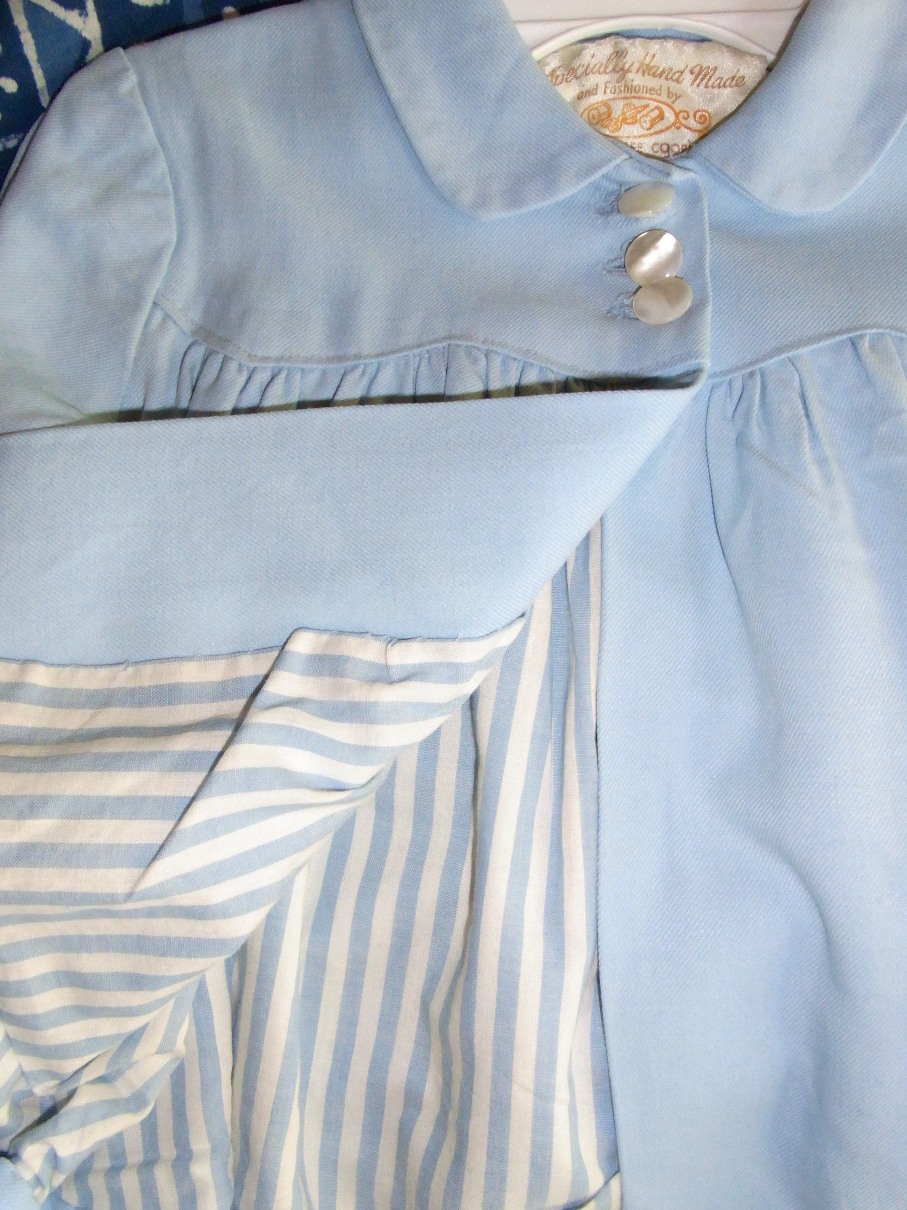
  My mom is an expert seamstress (though she doesn't sew much anymore) & you can see her hard work on these detail photos. I especially love the lining!

 We bought it in Nevşehir, in the Cappadocia region of Turkey. We also bought 3 boys' hats there...but those are in storage somewhere. I promise, after we move next week I'll get them all out for show. This page is quite a good reference if you'd like to learn more about Turkey...
 One thing that's interesting about the design is that the pieces of silk are all rectangles, but to make gussets & darts, (the places where humans bend & change size), they've created those with pieces of velvet & silk, in contrasting colors. The two top pictures show this design element pretty well, I think.
 I hope you like seeing these items. If you have any questions, let me know; we've learned a lot about textiles, weaving, embroidery, etc. as part of this hobby, and if I don't know the answer, I'm a librarian, so I can point you in the right direction...

 So here are a few items from the Sultanate of Oman. There's a good clothing article with lots more photos here. And a more authoritative article here (from the government). The little boy's dishdashah (above) is worn all over Oman, and you see them mostly in white, though sometimes in other pastel colors. This little girl's thawb (left), is typical of little girls all over Oman, but for adult women it's more typical of central Oman. It would be worn with loose pants, called al basta. The embroidery on this has been done with a sewing machine. Not that it looks any easier than doing it by hand--I've got some great examples of extremely intricate machine-stitched embroidery I'll share later.
 It dawned on my this morning that you might like to see real children in these clothes. Fortunately we took a digital camera with us when we went to Oman in 1998 and those photos are fairly easy to sort through (once I'd gone downstairs and dug out the backup hard drive). First of all, a photo of some children in an oasis near al-Mudhaibi, which is near our favorite souq, Sinaw. The kids were overjoyed because after walking around the oasis for a while we returned to find a goat on the hood of our car! (Goats will find any method available to get up into the trees for a good meal of leaves.) I think this photos illustrates my earlier point: most of the boys are wearing western clothing (the only boy in a dishdashah and kuma--Omani embroidered cap--is hidden by the others)...while the girls are dressed traditionally.
 Of course it's impossible for me to write a post about souqs in Oman without including a photo of a camel. And this is my favorite type of camel photo--a camel in the back of a small pickup! We saw these all over Oman (once we got out of the capitol) and I loved it; what a reminder that you're not in Kansas anymore, huh?!
