Showing posts with label ikat. Show all posts

Monday, August 26, 2013

Fake Ikat in Fashion!

A quick post to show you some fake ikat. Check out the photo from 1931 on that page & you'll see another thing I love about textiles: simple technology often produces amazing art. 

I posted recently about real ikat, & that post includes an amazing time-lapse video of a fiber artist, if you'd like to see how it's done.

This bag is made from fabric printed to look like it's been woven in the ikat method!  This bag is from Bungalow; saw it in a shop window in Charlottesville & had to run in & inspect. They have many fabric options for the bag, only a few are ikat-like.

I've noticed such printed (vs. woven) ikat elsewhere, too, lately.   Here are some bed linens from West Elm, for example.  

And shoes from DKNY here. 

And an iPhone cover here.

Notice I'm not even including pics from places like World Market or Pier One, or Ten Thousand Villages...where you would expect to see ethnic textiles used on products! 

Saturday, June 29, 2013

More Indonesian Artwork (from the collection)

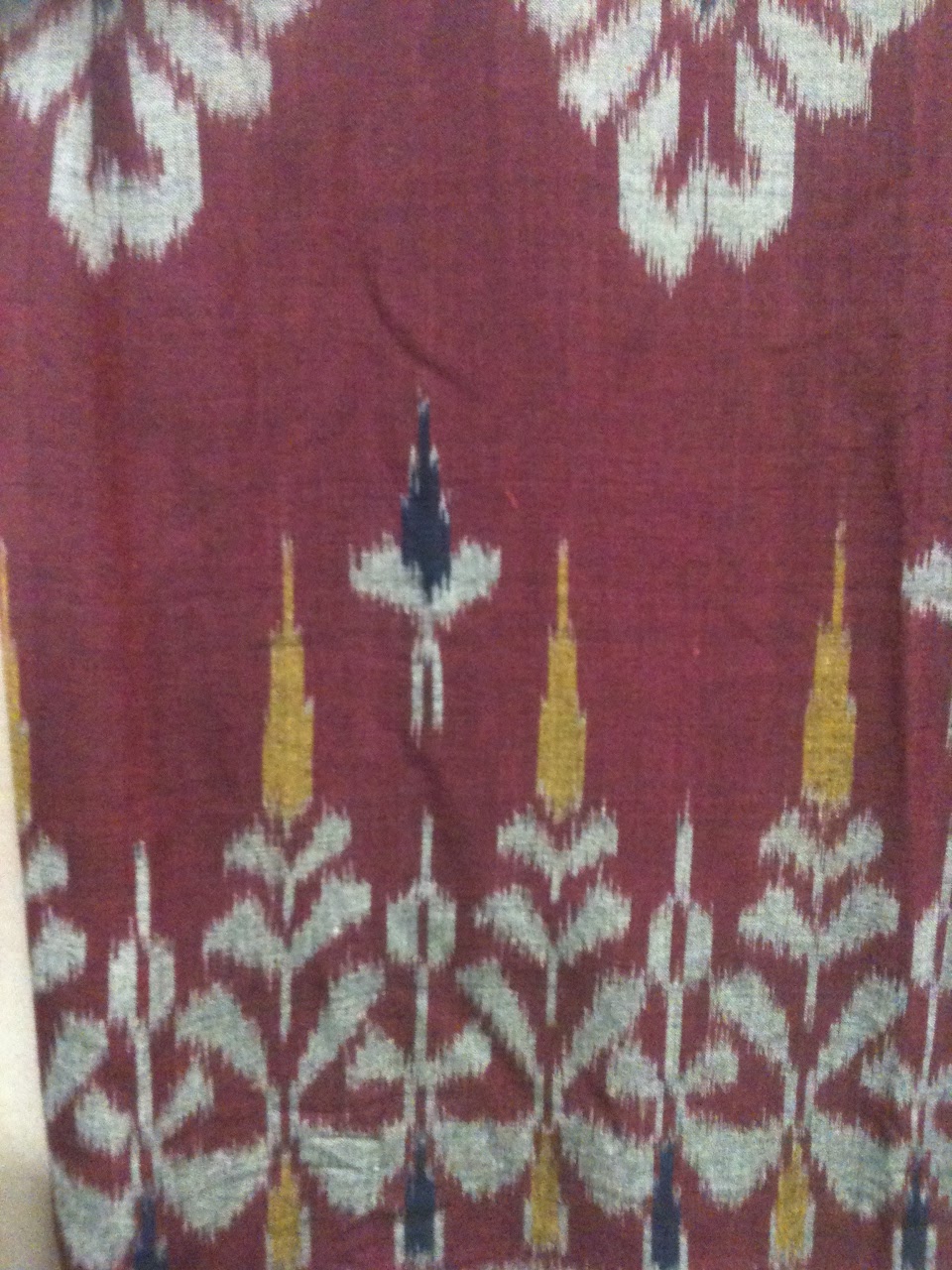
This first item is the Roommate's sarong for our 2 month trip to Indonesia.  Sarongs & sashes are required for many formal events (shrine festivals, theater performances), so these wearable souvenirs were one of the first things we bought.  

This is ikat, which I always think of as a fuzzy design.  Ikat is when the weft threads on a loom are dyed, then manipulated a bit so the edges of a design are not crisp.  There is also double-ikat, which is when both the warp & weft are dyed & manipulated.  Whitney Matalone has posted a riveting time-lapse video here. 

Ikat is called kasuri in Japan and is usually just done w/ two colors there.  Typically indigo & white or, less often, brown & white.  But you can see that in Indonesia, it's done with many different colors.  Either way, I find ikat pretty amazing.  As with batik, it takes a lot of planning & prep, but I think you'll agree it pays off in the end! 


An ikat sash.  The threads are not as fine as in
the sarong, making a less detailed pattern.


Friday, June 24, 2011

More Mohammed-Made-June

Okay, for all of you me-made-June-ites who are taking this seriously, please don't be insulted.  I'm doing Mohammed-Made-June because most of my non-pret-a-porter clothing was not made by me, but by my tailor from when I lived in Abu Dhabi.  A funny thing about this outfit:  I do NOT know where I got the fabric!!  I have this suit, and a similar ikat-look polyester/silk blend that was enough for a jacket, but don't know where it came from.  I'm guessing from our last trip to SE Asia?  Anyway it turned into a gorgeous suit, and I always get compliments on it.  It's in colors I like, and works well with my large collection of turquoise jewelry (a benefit of growing up in New Mexico).  The great thing about Mohammed, (and Marc's Mohammed, too) is they looked at the fabric & figured out ways to highlight the fabric's pattern on the outfit.  So the color & the hem of the skirt show the end of the woven pattern--a nice detail that most non-sewers never notice.  Apologies that it's a rather bad photo--we'd just got back from a Youssou n'Dour concert & it was late & we were tired, so didn't take a good look at the preview on our digital camera.

Wednesday, June 22, 2011

Japan - Textile Heaven on Earth

Front cover
Japan!  I'll start slow...there is so much great stuff in Japan, so many amazing techniques & so much style.  We have a ton of stuff (not enough, ever!).  When we lived there, we were poor & were saving for travel, so didn't spend much on souvenirs.  But in 2005 we went back for a week to see friends & our good friend, Noriko, took us to some antique shops.  We spent way too much, but even then, I didn't get a kasuri (ikat indigo) kimono.  What was I thinking?!  Anyway, in an antique store in outside of Tokyo, we happened upon this kimono pattern book. It's on heavy board, it would stand up by itself for the tailor, who would be working on the floor, as you can see on the photo below.

There are many styles of kimono in here, some very old-fashioned.  The book is about 14" tall - I've often wondered if I just cut the patterns out at this size if they'd work for a barbie doll?  

It was a real steal - about $5, and goes along well with our collection of weaving & textile tools collection (drop spindles, shuttles, fabric stamps, you get the idea).  

Fabric requirements
Pattern layout
On the picture above, you'll see 2 cotton kimono (my hapi, the roommate's yukata) which we've had since 1994.  Mine is about worn thru, so I'll probably use the fabric in something else soon, so I don't forget it.  The kanji (characters) on it are for the 4 seasons.  More Japanese  textiles later.  But now I'm going upstairs to work on my new dress!  More on that tomorrow...