Showing posts with label from-the-collection. Show all posts

Tuesday, July 29, 2014

From the Collection: Children's Hats from SW China - The Best is Last?

I mentioned that the Roommate & I often try to buy things in sets of three. Not sure why we do that, but it's a habit we've tried to keep up. Of course sometimes we cannot resist & we buy some other odd number of items (7 Ethiopian pillows, for example). Anyway, the best of these three amazing items, another child's cap from SW China, which we bought in Dali in 1994.

The front of this has an overlapping leaf design, and YES, that is real hair, braided & woven with some wire to make super-scary horns.  Wouldn't any child feel protected wearing this cap?  

I'm guessing it's also from the Bai people, but I need to do some more research.  We got them all in Dali at the same time.  

BTW, they were made for wearing--all three have chin-straps.  

Enjoy the details below...


Note: Clicking on the photo will bring up a much larger version for your perusal.

Tuesday, July 15, 2014

From the Collection: Children's Hats from SW China - 2nd Entry

Another child's cap from the Bai people in SW China.  The first in this little series is here. Gorgeous embroidery & details on this scary face.  Not sure what's in the nose--it's quite hard, and feels like it might be wood?  I am especially partial to the teeth! I also love the mouth & eye details, including super eyebrows, which reminds me...

You'll be glad to know the Roommate & I try to shop in threes...so another one is coming (and I've saved the best for last)!

Tuesday, July 8, 2014

From the Collection: Children's Hats from SW China!

The Roommate & I will be on a big trip thru Finland & Iceland to celebrate our 30th wedding anniversary (yes we are proud!), so the next few weeks I'll be sharing a few items From the Collection. I hope you enjoy these lovely examples of folk art.

Think about this: you're a parent in pre-science culture.  You see the high death rate of children, especially babies.  Even if you have a clue about clean water or immunizations, you have no way to put that knowledge into daily use.  So you might try other methods to ensure the health & success of your baby.  These children's hats, richly embroidered & decorated, are an attempt to ward off evil spirits, while also ensuring luck, wealth, happiness & longevity. 

The scary face would definitely give an evil spirit a fright, don't you think? 

This hat is from the Bai people, an ethnic minority in
SW China (we purchased this cap in Dali in 1994). 

The exquisite embroidery, along with the fake fur, and a little trapunto (for the nose), give this cap a distinct personality.  I imagine a little boy or girl would be thrilled to wear such a scary cap, the equivalent of the superhero capes Western children wear.  The row of Buddhas will bring luck and wealth.  

Lotus embroidered on corduroy
used for the back of the cap. 

The lotus flower (above) endows purity on the wearer while the bird may mean a messenger or a shaman.  I can guess, but really, will never know what the mother or grandmother or aunt or sister was thinking when she made this treasure for a new member of the family. 

I'm a librarian, so compelled to include a bit of reading in case you'd like to find out more:
Symbolism in Chinese Children's Hats & Baby Carriers (2007)
and even more reading (on the Bai & Miao, but other ethnic minorities, too)!

Tuesday, May 13, 2014

It's a Quetzal Kind of Day!

Unless you're an avid birder, or into punk-rock hairstyles, you may not know what a quetzal is. Well, for one thing, quetzales are the national bird of Guatemala.  The money is also called Quetzales--I love that!  
Source
I haven't ever seen one in the wild...not for lack of trying.  The Roommate & I have spent lots of times traipsing in rainforests, following a guide, trying to see through dripping leaves & damp binoculars.  
Source
They are well & truly amazing, and are a common icon for all types of artwork, whether it's for a Mayan ruin, or a huipil, a woman's tunic.  

I've mentioned before that styles of huipiles are fairly useful to determine the wearer's hometown.  

Here another from our collection of 7 (never enough!), both with quetzales as the extremely amazing subtle, repetitive, interlocking embroidered icon.  I cannot think of enough adjectives to describe my feeling of wonder when I look at these works of art!  

(Note: The photos are small on this page, but click on them to see the full-sized versions & admire the detailed handwork.)

From Quetzaltenango (place of the quetzales), here's a masterpiece.  BTW, I'm not 100% sure of the origin of this item.  If you know better, please leave a comment for me!  If you want a glimpse into the complicated world of Guatemalan geography & huipile art, check out Huipils, for their list of towns, each with distinctive embroidery & weaving styles.  


Embroidered quetzales--perfectly kerned!  

 The mini zipper at the neck is so charming.

Each shoulder has a band of velvet.

What's fascinating to me about this particular huipil is that it looks to be made of a basic cotton rice or potato sack, then heavily embroidered with the kerned quetzales in multiple colors. THEN, a completely different design & type of embroidery was applied with finer thread.  At first I was sure that this was machine embroidery, but after some thought, I don't think it's very likely on a huipil that is a at least 25-30 years old.  
From reading about these vertical bands, they were apparently first used to disguise seams when narrow bands of fabric had to be pieced together.  Because they were so beautiful, when wider base fabric became available the decoration was retained, though it was no longer needed.  

Stay tuned.  I'll have another huipil up next week.  Comments/Questions?  Let me know.

Tuesday, October 8, 2013

From the Collection: Straw Into Gold

Whenever I look at weaving or knitting, or ikat or batik or crochet or quilting, I think "straw into gold." Which is really what any type of textile craft/design/skill/creation is...

Artists take this


or this 


or even this 
then turn it into fiber...then into art!

This is a skirt (falda) from Guatemala.  It's cotton & woven of fibers not much thicker than the thread used for sewing.  And it's incredibly long (33" x 152"), meaning that it must have taken ages to make.  The narrow ends are sewn together to make a loop and the women step into them, then wrap them around and tie them with a belt (cinturon). 

This is a Baluchi woolen rug, from northern Oman.  Though the wool is quite coarse, I love that the design is so intricate, again a lot of work (and paying attention).  The dyes are all traditional, too, which is hard to find. 

Here's another example of amazing work, but with modern dyes, a woolen rug from southern Egypt.  

And one example of Navajo weaving...a saddle blanket. Probably from the 1930s (again, natural dyes give a hint of age, but also that it's worn).  But I'm no expert!

And another Navajo weaving, a chief's blanket, also from the 1930s.  The dyes are in better shape on this one...perhaps because it was used less (it would have been worn around the shoulders, not sat on)?  

Finally, a recent arrival to the collection...a friend just gave me this, she got it in Thailand. It is very finely woven with cotton and silk yarn not much thicker than sewing machine thread!  I cannot begin to imagine how much time this took! 

To give you an idea of the work involved, here's a picture showing the back & front.  Sorry the photos aren't the best; there seemed to be a glare off the fabric, which is one of the reasons I'm pretty sure silk is one of the materials.  

I just realized I have a class tomorrow evening at Bits of Thread, so have to go prep for that!  Thanks for reading!  

Tuesday, July 30, 2013

More Batik & the Technique of Reverse-Thinking

Purchased in Indonesia, I wore this sarong
quite a bit--now it's part of a bedspread!
So here are some examples of batik, the wax-resist art mostly associated with Indonesia, though we have some African & Dutch examples too.  The first (top) is from Indonesia & is fairly simple.  Essentially you go in reverse...the white is the original color of the fabric, so start thinking in reverse...and start planning! 

Wax is then painted on (or stamped, or even printed, as in the top example), and everything covered in wax stays white, while the artist dyes the next color.  For the two color items, it seems fairly easy...but what about the multi-color fabric?  Thinking in reverse is not one of my strong suits.  Nor is planning!  


These two examples, one hand-drawn, one stamped or printed, are great examples of traditional indigo batik.
Dutch wax-resist, purchased in Muscat.  Also
part of the same bedspread.
This last example, though, was purchased in Java, and is a great example of the Javanese batik technique, which is often multi-colored and extremely detailed.  
Here's a longer (17 minute) video, from Moda Batiks in Indonesia, which does a nice job of demonstrating tie-dye techniques, using a copper stamp, sprinkling salt on the fabric to set the dye, etc.  

The "salt effect" mentioned at 9:45 is, I believe, a difference between soaking the fabric in salty water vs. sprinkling salt.  Soaking the fabric would set all color, whereas the sprinkling/salt effect, along with the sun, means that only part of the color is set, while the sun bleaches out the fabric that didn't get the salt sprinkling.  I hope that makes sense!  

The planning (or ability to think in reverse) is what fascinates me...I'm sure it's easier the more you do it, but I find so often in my sewing that my reverse-thinking needs work!  

Saturday, June 29, 2013

More Indonesian Artwork (from the collection)

This first item is the Roommate's sarong for our 2 month trip to Indonesia.  Sarongs & sashes are required for many formal events (shrine festivals, theater performances), so these wearable souvenirs were one of the first things we bought.  

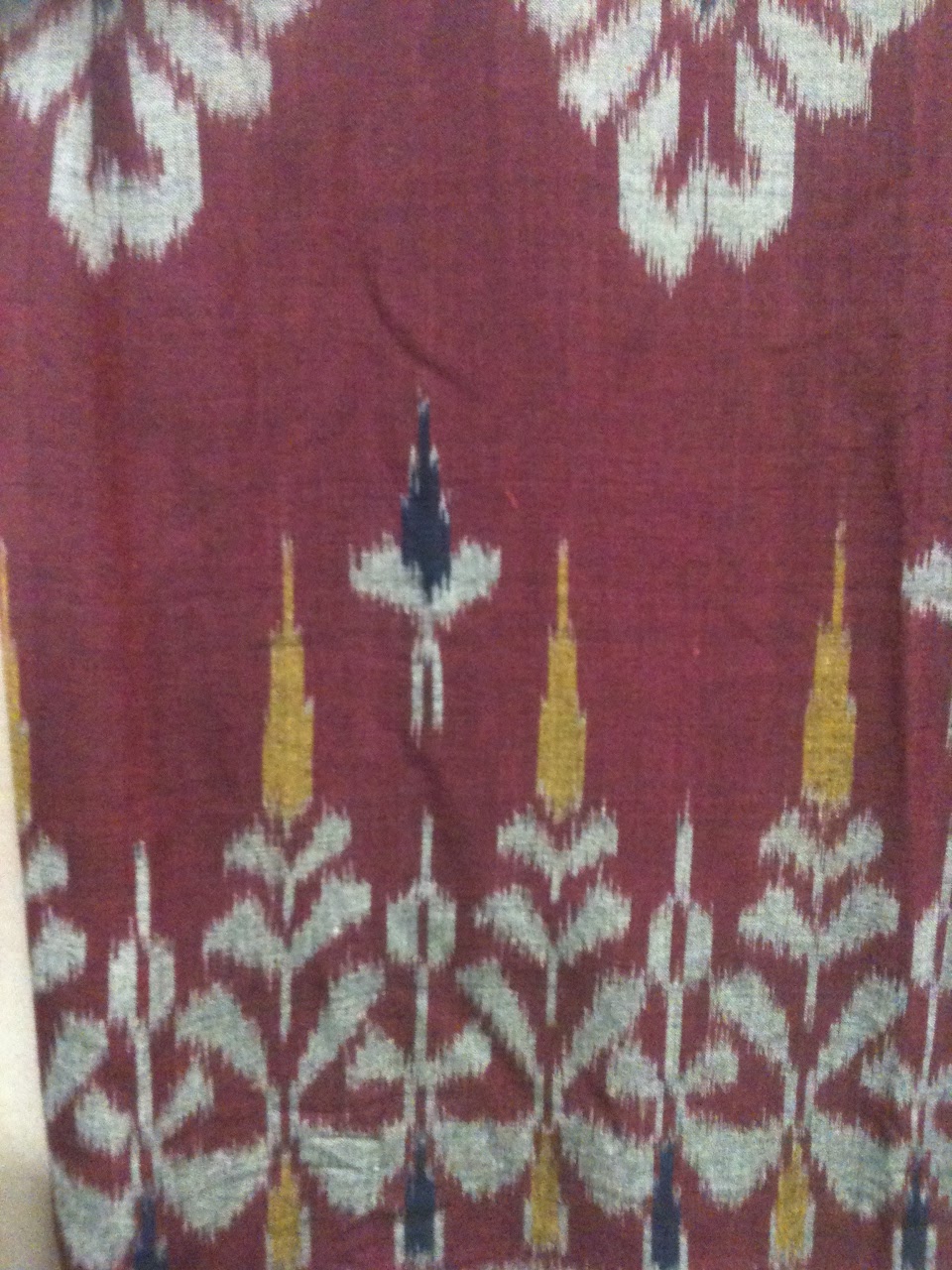
This is ikat, which I always think of as a fuzzy design.  Ikat is when the weft threads on a loom are dyed, then manipulated a bit so the edges of a design are not crisp.  There is also double-ikat, which is when both the warp & weft are dyed & manipulated.  Whitney Matalone has posted a riveting time-lapse video here. 

Ikat is called kasuri in Japan and is usually just done w/ two colors there.  Typically indigo & white or, less often, brown & white.  But you can see that in Indonesia, it's done with many different colors.  Either way, I find ikat pretty amazing.  As with batik, it takes a lot of planning & prep, but I think you'll agree it pays off in the end! 


An ikat sash.  The threads are not as fine as in
the sarong, making a less detailed pattern.


Friday, June 21, 2013

Indigo Batik - from the Vault!

On the left, below, is the sarong I mostly wore during our 2 months bumming around Indonesia in 1995.  For visits to all shrines and some performances (shadow puppets, kecak dance, traditional dance), a button down shirt & sarong & sash were required for both the Roommate & I.  
I believe it was made with a stamp?  Or a printer?  Is there a printer that dispenses hot wax?  I should look into that.  The pattern is very regular overall.  


Anyway, the fabric on the right is some less-precise batik, which looks totally hand-drawn by someone with a tjanting tool.  The design is fairly regular, but not perfect.  I bought 2 of these sarongs, and later had them made into a bedspread, which got quite faded in Oman...even with the curtains closed!  (Just a LOT of light there.)  

The link for tjanting will take you to Dharma Trading, where you may want to have a look at some of the batik stamps, too, just to get an idea of how those work.  

Batik is one of those techniques that is very difficult for me to think about...because the artist must keep preserving the lighter color with wax, then dying it darker & darker & darker.  With 2 colors, it's not so difficult (though there is so much white on the first batik, above...what kind of stamp was that?)...however, it's sort of like relief carving...you have to take away the air, and leave the thing you want the carving to show.  It all seems sort of reverse and counter-intuitive to me!  

Hope you enjoy seeing these; I'll show some more batik, from India, Africa & Java soon.

Saturday, June 8, 2013

Palestinian Embroidery

 Quick post about a pillow we have covered with extremely distinctive & wonderful Palestinian embroidery (a.k.a. tatreez fallahi/cross-stitch embroidery/عبر غرزة التطريز).  Often it's used as decoration on bodices, cuffs, hems, headdresses.  There's a great picture on that second link of 2 women pulling up their white sheilas to show off their amazing bodice embroidery, which they probably did themselves.  Amazing detail and wonderful graphic designs.  We have another pillow (which I can't find!), but really, I should have bought 10 or 20 of these.  I was always kind of waiting to find an actual dress somewhere at the souq, but that never happened, and I ended up with very little instead.  Big mistake!  ;-)

However, who cares if I have enough samples of this amazing work?  What matters is that Bella loves it, finds it a cozy place to hang out, and it flatters her lovely coat.

Sunday, March 31, 2013

Kuchis Wedding Dress


I'm having a hard time figuring out exactly what this is.  I suspect it's a wedding dress worn by women of the Kuchis people of Afghanistan.  

The Kuchis are Pashtun-speaking nomads, who heavily embroider their wedding dresses.  And we've got one.  The Roommate gave it to me for xmas a few years back.  It was easy to get Afghan goods when we lived in Abu Dhabi.  Unfortunately we never got to Afghanistan, so the souq in Abu Dhabi was the best we could do.

I have been scouring the web for information about this type of garment, and would love to show you a photo of a bride wearing one.  Though I have found plenty of dresses, modern & vintage that look similar, I'm finding very little about who would have worn these dresses, why and where.  That they're worn by Kuchis women is about the closest I've gotten, and because weddings are a big deal the world over, I'm making an educated guess about the purpose of this garment.  I feel sure that though this is a longer dress, it would probably be worn over a pair of loose pants.  
Waistband detail + 3 medallions

The top is heavily embroidered with glass beads and metallic thread.  Round medallions of varying diameter are at the waist, the shoulders and on the sleeves.  The sleeves have the finger loop (also beaded) that would go over the middle finger to keep the sleeves down.  Although the dress itself doesn't seem that big (for an average sized woman), the sleeves are very long (and we had to fold them a bit to get them to fit on this 5' wide rod).  

Sleeve detail: mirrorwork &
metallic thread embroidery
This dress is heavy...the bodice is so thoroughly embroidered that it is stiff and the glass beads, mirror-work (shisha), and metallic thread bring it in at just over 9 lbs!  These are all common textile-decoration techniques from the NW of India, Pakistan & Afghanistan. Remember by common I don't mean simple!  Just that they're from a time period where most women had amazing hand-work skills and plenty of hours to learn these skills & to show them off. 


Skirt embroidery detail
If you're interested in a great book about textile techniques around the world (including many "how-to" instructions, such as adorning your latest creation with some mirrorwork), check out A Visual Guide to World Textiles by John Gillow & Bryan Sentance from Thames & Hudson.  And one online store, Tribal Bazaar, has all sorts of amazing photos; I've never purchased from them, so don't know if they are reputable; but it's fun to look at their photos!  

The Roommate & I took many photos trying to get all the details showing to share with you.  Enjoy!  (Remember, clicking on a photo will take you to the full-size version of that photo.)  Thanks for visiting & I'd love some comments if you know a bit more about this type of dress!  

3.5" medallion detail; one at each cuff

Saturday, November 3, 2012

The Roommate Gets a New ゆかた (浴衣)

We lived in Japan from 1993-1994, teaching English at an eikaiwa (conversation school).  The Roommate got this yukata (cotton kimono) there and we both love it because of the writing and the graphic quality of that writing.  I have no idea what it says, but I love writing systems, and this satisfies on so many levels. 

However, it's wearing out.  The seams are holding up, but the fabric is worn through in many places.  I have new fabric for another, but am dismantling this yukata so that I can re-use it as lining for the new one (at least the parts I can re-use...probably just the lower half.  I started dismantling (okay, seam-ripping!) and then began to wonder just how long it had been since I'd washed it.  So it's in the dryer right now...just to be sure I'm working with a clean version.  

I dug out my Japanese kimono pattern book (see below), and have been using the proportions from that, along with measurements from the existing robe.  Japanese kimono use most of the fabric because the pattern pieces are essentially just rectangles; they're also fairly easy to make because there is not really fitting in terms of width, it's the length that has to be modified, depending on the wearer's height.  If you're at all interested in purchasing used kimono to re-use for fabric, it is a pretty good idea--you won't get a bunch of tiny pieces that you can't do much with.  Lots of rectangles, and the back is often one large piece, not 2 pieces sewn together.  
Very little wasted fabric with a kimono pattern!
I finished it!  I had lots of time (Hurricane Sandy means no work today or tomorrow), plus I couldn't go anywhere (not safe to be on the streets), and the Roommate was out of town (stuck in SFO & couldn't get a flight back), so it was a great time to work on a present that wasn't meant to be a surprise, but why not?  The situation definitely called for it.  

See what you think...he picked out the fabric.  I wanted to use one of my West African wax prints (thinking "What a crazy mix--African batik & Japanese clothing!"), but he didn't like that idea.  It's an Alexander Henry print (I was going thru my scrap box & noticed his name was on a LOT of selvages!), that I got from an Etsy Shop, Lucky Frog (Lucky Kaeru).


Nigiri Sushi Yukata


Sunday, September 30, 2012

From the Collection: Weaving - Bolivia & Ghana

I'm working on a few projects I hope to share soon, but in the meantime, thought you'd enjoy seeing more from our textile collection...

This first one is a saddle blanket from Bolivia.  It's extremely fine wool (in terms of gauge), but isn't that soft--it seems as though it'd be fairly durable.  Probably goat?  Definitely not one of the higher quality wools from the region like guanaco or llama or alpaca.  It has some amazing detail (see below). 


I also believe it was repaired at some point, not surprising for a blanket used on a pack animal.  However, the repair work is also pretty amazing--though it doesn't reconstruct the original pattern, it is as tightly woven, and looks quite sturdy.    


I really love the idea that this blanket had a utilitarian purpose, but was designed and crafted beautifully, even if it was going on the back of a pack animal!  So it protected the animal, and possibly made the owner happy every time s/he looked at it.  It certainly makes me happy when I look at it.

Another item decorating the living room right now is this kente cloth, from Ghana.  It's woven from silk & rayon (I think).  I feel like it's silk because of the luster, but that it must have rayon in it because it's fairly sturdy (we have another 100% silk kente that is fairly worn--silk is amazing, but fragile).  

If you've read my comments on weaving before you'll know right away that this is strip-weaving at its finest.  The strips are about 3" wide and are stitched together to make an eye-catching design.  Weaving on such a narrow loom means the loom is extremely portable and can be moved mid-project, then hung from a tree or fence post and used immediately.

Here are a few detail photos of this kente.  


Questions?  Comments?  Please leave them below.

Music:  The XX, "Angels," definitely Sunday morning music!