I was quite fortunate to be asked recently to write a guest post (as an overeducated seamstress) on Seamstress Erin's blog, so I wrote about what I love most (besides the Roommate & Bella): travel & textiles!
In honor of Erin's recent completion of her PhD, she's asked a bunch of other overeducated sewists to blog. My post is about textiles we collected in Ghana, Japan, Thailand & Ladakh.
Congrats to Erin; thanks for the honor...and my apologies for being a bad sewing blogger right now. The weather is amazing here (eternal spring!), and we have been spending a lot of time working on our yard (after 3 years of doing almost nothing). We're building a rock wall now!
Finally, if you liked my country music clothing posts (after a trip to Nashville), you might enjoy this article about a new photography exhibit in LA (Country Music Icons). Of especial interest is a photo of Gram Parsons in his leather suit, along with Nudie Cohn, the tailor who designed many of the amazing outfits seen in these photos & in my older posts.
Showing posts with label japan. Show all posts
Tuesday, May 27, 2014
Tuesday, December 18, 2012
A little project with some Japanese silk
Don't get me wrong, I like Ikea. But there are some things they do better than others. Bathmats - YES! Lights - NO! All their lights, especially the table lights, only allow very low wattage light bulbs, which means that you need about twelve to get enough light to read.
Our front room/living room is fairly dark because it just has one main light in the center of the ceiling. We already replaced what was there with a much better, brighter, light, but still, if you're in the corners, you need more light. An Ikea floor lamp serves us well behind our love seat (also Ikea!). But even though we had two cool lime green table lamps on our dining room table, we still couldn't see worth a darn when reading or eating.
So last weekend we headed over to Lowe's and bought a better lamp with a plain off-white shade. And then used a piece of kimono silk to recover it, using Momtastic's instructions. I recommend looking the instructions over before you get started...a flat piece of fabric won't work unless you want pleats. You have to make a curvy pattern to make it fit the shade smoothly.
The before (use your imagination), an off-white shade. The after? See below. And no comments on the photography, please! ;-)
Music?! How about Shine a Light?
So last weekend we headed over to Lowe's and bought a better lamp with a plain off-white shade. And then used a piece of kimono silk to recover it, using Momtastic's instructions. I recommend looking the instructions over before you get started...a flat piece of fabric won't work unless you want pleats. You have to make a curvy pattern to make it fit the shade smoothly.
The before (use your imagination), an off-white shade. The after? See below. And no comments on the photography, please! ;-)
Music?! How about Shine a Light?
Saturday, November 3, 2012
The Roommate Gets a New ゆかた (浴衣)
We lived in Japan from 1993-1994, teaching English at an eikaiwa (conversation school). The Roommate got this yukata (cotton kimono) there and we both love it because of the writing and the graphic quality of that writing. I have no idea what it says, but I love writing systems, and this satisfies on so many levels.
However, it's wearing out. The seams are holding up, but the fabric is worn through in many places. I have new fabric for another, but am dismantling this yukata so that I can re-use it as lining for the new one (at least the parts I can re-use...probably just the lower half. I started dismantling (okay, seam-ripping!) and then began to wonder just how long it had been since I'd washed it. So it's in the dryer right now...just to be sure I'm working with a clean version.

I dug out my Japanese kimono pattern book (see below), and have been using the proportions from that, along with measurements from the existing robe. Japanese kimono use most of the fabric because the pattern pieces are essentially just rectangles; they're also fairly easy to make because there is not really fitting in terms of width, it's the length that has to be modified, depending on the wearer's height. If you're at all interested in purchasing used kimono to re-use for fabric, it is a pretty good idea--you won't get a bunch of tiny pieces that you can't do much with. Lots of rectangles, and the back is often one large piece, not 2 pieces sewn together.
I finished it! I had lots of time (Hurricane Sandy means no work today or tomorrow), plus I couldn't go anywhere (not safe to be on the streets), and the Roommate was out of town (stuck in SFO & couldn't get a flight back), so it was a great time to work on a present that wasn't meant to be a surprise, but why not? The situation definitely called for it.
See what you think...he picked out the fabric. I wanted to use one of my West African wax prints (thinking "What a crazy mix--African batik & Japanese clothing!"), but he didn't like that idea. It's an Alexander Henry print (I was going thru my scrap box & noticed his name was on a LOT of selvages!), that I got from an Etsy Shop, Lucky Frog (Lucky Kaeru).
However, it's wearing out. The seams are holding up, but the fabric is worn through in many places. I have new fabric for another, but am dismantling this yukata so that I can re-use it as lining for the new one (at least the parts I can re-use...probably just the lower half. I started dismantling (okay, seam-ripping!) and then began to wonder just how long it had been since I'd washed it. So it's in the dryer right now...just to be sure I'm working with a clean version.

I dug out my Japanese kimono pattern book (see below), and have been using the proportions from that, along with measurements from the existing robe. Japanese kimono use most of the fabric because the pattern pieces are essentially just rectangles; they're also fairly easy to make because there is not really fitting in terms of width, it's the length that has to be modified, depending on the wearer's height. If you're at all interested in purchasing used kimono to re-use for fabric, it is a pretty good idea--you won't get a bunch of tiny pieces that you can't do much with. Lots of rectangles, and the back is often one large piece, not 2 pieces sewn together.
| Very little wasted fabric with a kimono pattern! |
See what you think...he picked out the fabric. I wanted to use one of my West African wax prints (thinking "What a crazy mix--African batik & Japanese clothing!"), but he didn't like that idea. It's an Alexander Henry print (I was going thru my scrap box & noticed his name was on a LOT of selvages!), that I got from an Etsy Shop, Lucky Frog (Lucky Kaeru).
![]() |
| Nigiri Sushi Yukata |
Thursday, April 19, 2012
Shibori no Haori / しぼりのはおり
I want to show you a haori I got the last time we were in Japan. A haori is a short kimono, worn over another kimono, mostly for warmth. But originally they were worn by men, and used to protect a kimono from the elements. This kimono is silk, and you're looking at the back of it in this photo. It would not be worn with an obi, which is the wide decorative belt.
What makes this haori especially amazing is the extremely detailed tie-dye technique the Japanese use called shibori. We all know about tie-dye with rubberbands to make hippie t-shirts, but the Japanese, not surprisingly, as a nation of overachievers, have to do it the hardest way possible (with the most amazing results): with a needle and thread.
Look at the detail of this haori, in the second photograph. It looks to me as if they made 10-11 little circle knots in each row! And there are 3 rows in each group...and you can count yourself (if you like) the number of groups across each row on this fabric. All I have to say is, "I love admiring this artistry, but I do not want to do it myself!"
If you do want to do it yourself, check out this page from Victory Patterns. It's got a great after picture, with lots of before shots showing the hard work involved in pre-dye stitching.
The final photo shows the oh-so-classy lining of the haori. Maybe when I get tired of looking at the back I'll swap it around and pull back one of the sides to show the lining, too.
We've been out in our yard a lot, and I despair of getting my sunflowers to bloom in our extremely shady yard (2 huge holly trees, a gigantic oak and a very large poplar). But it's great for all the textiles because just about the worst thing--besides the oil on your fingers--is light.
So...music? Pavement: Shady Lane
Sunday, April 15, 2012
The Tawaraya Workshop - Textile Museum Exhibition
The Roommate & I went into town in the early afternoon as we wanted to see the Woven Treasures of the Tawaraya Workshop exhibition at the Textile Museum. The silk fabric was amazing, no surprise there, and they even had some of the ceremonial kimono used by the Imperial Household. For example, the bridal kimono of the Empress Kojun (Mrs. Hirohito to you & me)! The Gallery Guide is here.
But then we went up to see a short film about the director, Kitagawa Hyoji, a National Living Treasure in Japan, head of the Tawaraya Weaving Workshop. He doesn't just make amazing woven fabrics for court ceremonies now, he recreates 1000+ year old textiles found in Japan's museums & shrines. This includes not just matching color & weight of the silk, but also reproducing the weaving style. He spends a lot of time setting up looms & looking through a magnifying glass!
When 皇太子妃雅子 (Masako-san) was married in Japan, in 1993, of course the kimono were woven at Tawaraya. A fun exhibit & highly recommended.
But then we went up to see a short film about the director, Kitagawa Hyoji, a National Living Treasure in Japan, head of the Tawaraya Weaving Workshop. He doesn't just make amazing woven fabrics for court ceremonies now, he recreates 1000+ year old textiles found in Japan's museums & shrines. This includes not just matching color & weight of the silk, but also reproducing the weaving style. He spends a lot of time setting up looms & looking through a magnifying glass! When 皇太子妃雅子 (Masako-san) was married in Japan, in 1993, of course the kimono were woven at Tawaraya. A fun exhibit & highly recommended.
Monday, November 28, 2011
Ahh, those days w/ servants!
![]() |
| risingsunimports.com |
So I got a kick out of an article I saw on the plane about Sayuki, the first white geisha, who has begun selling つけ帯, or self-tie obi! Here's the website, in case you need to get yours before the new year holidays, and there's a video about how to put it on--without the help of your servant! According to Sayuki, geisha have been using such obi for years...
Tuesday, November 22, 2011
Japanese crafts
Thought you'd like to see two interesting gifts that the Roommate & I received from students when we lived in Japan.
On the left is an origami Girls' Day display. Girls' Day, also known as Hinamatsuri (雛祭り), or Doll Festival, and in most homes there would be a large or small display of dolls (doll size influences display size). At the top are the Empress & Emperor, then below, various courtiers, including guards & musicians. A student had made this as part of a class assignment for public school, then brought it in to show the Roommate. He asked what she was planning to do w/ it: "Throw it away." NOOOOO! So of course he brought it home to me & it's been treasured ever since & on display in the 9 places we've lived since then. It's in my sewing room now.
On the right is a cloth representation of Murasaki Shikibu (紫 式 部), a pen name for one of the earliest novelists anywhere. She wrote The Tale of Genji in the 11th century. When we left Japan, one of my students gave it to me. Her mother had made it. I thought it was nice, but my co-workers informed me that the student's mom is probably an expert & most likely a teacher of this craft--they could see the artistry and skill in it, even if I couldn't. I do love it though, and it's been another treasure that has decorated our various living quarters throughout the world.
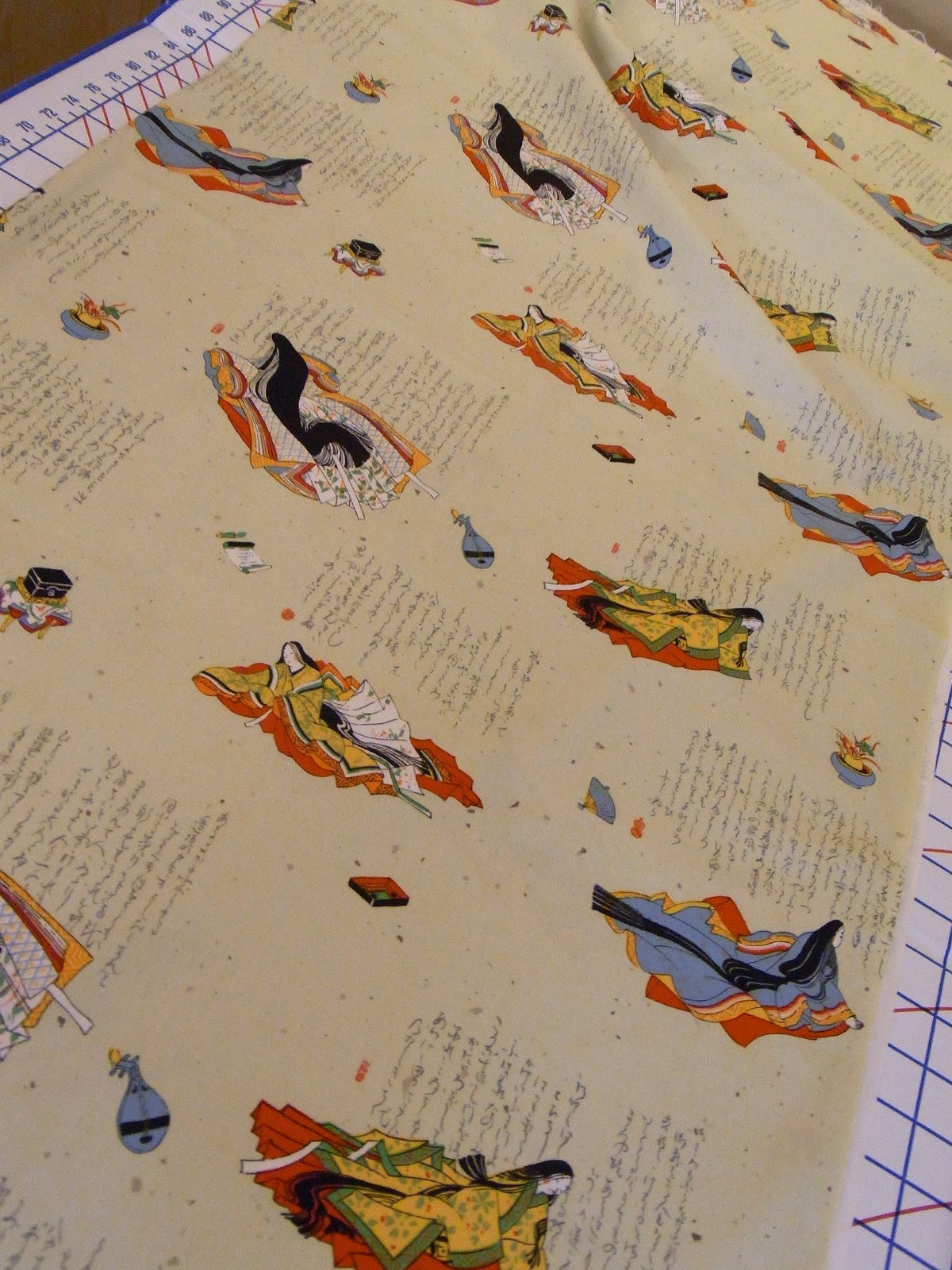
You may remember that my yukata was made from fabric representing Japanese women poets lounging. Here's the post showing that fabric. I have tried to decipher the very stylized writing to figure out which poet is which--but I haven't figured out which one is Murasaki yet.
On the left is an origami Girls' Day display. Girls' Day, also known as Hinamatsuri (雛祭り), or Doll Festival, and in most homes there would be a large or small display of dolls (doll size influences display size). At the top are the Empress & Emperor, then below, various courtiers, including guards & musicians. A student had made this as part of a class assignment for public school, then brought it in to show the Roommate. He asked what she was planning to do w/ it: "Throw it away." NOOOOO! So of course he brought it home to me & it's been treasured ever since & on display in the 9 places we've lived since then. It's in my sewing room now.
On the right is a cloth representation of Murasaki Shikibu (紫 式 部), a pen name for one of the earliest novelists anywhere. She wrote The Tale of Genji in the 11th century. When we left Japan, one of my students gave it to me. Her mother had made it. I thought it was nice, but my co-workers informed me that the student's mom is probably an expert & most likely a teacher of this craft--they could see the artistry and skill in it, even if I couldn't. I do love it though, and it's been another treasure that has decorated our various living quarters throughout the world.
You may remember that my yukata was made from fabric representing Japanese women poets lounging. Here's the post showing that fabric. I have tried to decipher the very stylized writing to figure out which poet is which--but I haven't figured out which one is Murasaki yet.
Tuesday, October 11, 2011
Yukata! - In which I decide I need a dress form...
So, I finished it. Again, I need to reiterate how pleased I am about how well the batik (blue) goes w/ the Japanese poet print. You can see from the photo at right how messy my house is...NO! you can see that it is really a boxy Japanese kimono pattern, modified a bit to hopefully be a bit more flattering. However, there is so much bulk under the arms, at the side seams. I do like the final result & will wear it a lot (it's so loose that I can wear my pajamas underneath it easily)...but, I may try to think of a way to take in the side seams to reduce some of said bulk.
I need to mention though, that kimono are not meant to be shaped, the pieces are rectangles made to efficiently use the narrow woven fabric. When we lived in Japan, one of my students was studying tea ceremony (the Japanese make everything an art & it always involves lots of study & practice)...and she had to wear a kimono. She told me that her kimono hated her! This student, Akiko, was a normal female shape, but she said that when you wear kimono, you have to have no shape. "Like the trunk of a tree," was how Akiko put it! Which surprised me, but if you think about it, she's correct (look at some photos from Kyoto, if you need more evidence). Which again brings me to the question of why I thought I would get a shapely housecoat if I copied a kimono pattern? Oh well...it was a fun project.
A reminder, a yukata is a kimono, but made from cotton, not silk or wool. It's a summer kimono, essentially. If you've ever spent a summer in hot, muggy, Japan, you know why they invented this version of the kimono!
Here's the back--you can see I added some darts in the back to give it some shape. I also added them in the front, but they don't show much because of the overlap.
I had to look at the Roommate's yukata to figure out how to do the underarms. Attaching the sleeves was easy enough--just lots of straight line sewing, but after sewing up that little flap at the bottom of the sleeve, there's actually a gap in the fabric. I top-stitched that to make it lay smooth & look nice.
I tried it on w/ my hapi coat belt, but the Roommate & I didn't think it looked very good, so I decided to make tie fasteners. There are 4 of them, and I'm also quite pleased with them--I made them by folding the fabric 4 times and sewing a few times--so they are rather sturdy & flat--and I think they make nice little knots. 2 are inside, where they don't show, so that the overlap stays put.
One thing I kept coming up against over & over was how to fix it while it was on me. The Roommate is extremely helpful & willing to do most anything w/ regards to textiles & sewing, but he doesn't always "get" what I'm talking about. I really feel like a tailor's dummy, or dress form, or adjustable mannequin is the next item I want for my sewing room. I may have to wait a while--we have to pay for our new south wing, first! The duct tape version is looking better and better!
Another issue...of course I don't have any matching pajamas! Uh oh. I do have some great stretchy fabric that sort of matches, maybe I'll make some pants out of that.
I need to mention though, that kimono are not meant to be shaped, the pieces are rectangles made to efficiently use the narrow woven fabric. When we lived in Japan, one of my students was studying tea ceremony (the Japanese make everything an art & it always involves lots of study & practice)...and she had to wear a kimono. She told me that her kimono hated her! This student, Akiko, was a normal female shape, but she said that when you wear kimono, you have to have no shape. "Like the trunk of a tree," was how Akiko put it! Which surprised me, but if you think about it, she's correct (look at some photos from Kyoto, if you need more evidence). Which again brings me to the question of why I thought I would get a shapely housecoat if I copied a kimono pattern? Oh well...it was a fun project.
A reminder, a yukata is a kimono, but made from cotton, not silk or wool. It's a summer kimono, essentially. If you've ever spent a summer in hot, muggy, Japan, you know why they invented this version of the kimono!
| Under the arm, where the sleeve (R) is attached |
One thing I kept coming up against over & over was how to fix it while it was on me. The Roommate is extremely helpful & willing to do most anything w/ regards to textiles & sewing, but he doesn't always "get" what I'm talking about. I really feel like a tailor's dummy, or dress form, or adjustable mannequin is the next item I want for my sewing room. I may have to wait a while--we have to pay for our new south wing, first! The duct tape version is looking better and better!
Another issue...of course I don't have any matching pajamas! Uh oh. I do have some great stretchy fabric that sort of matches, maybe I'll make some pants out of that.
Wednesday, October 5, 2011
Not OK Kimono!
Okay, we can all have a little think about What was I thinking? now. Here's what's up: I did translate most of the kimono pattern into English; at least I did enough so I could use it to make myself another yukata. And I could have used the measurements in the pattern (it's in centimeters), but for some dumb reason I decided to use the old measurements for my hapi coat. Which was big & boxy. I realize that the kimono would have been boxy, too, but narrow boxes, not wide boxes. Why did I do that? Now I have a voluminous housecoat that doesn't really look good when I wrap a belt around it. It looks so bad, in fact, that NO! You cannot see a picture!
I am however quite pleased with my fabric choices, so I'll post a picture of it so far so you can admire that:
I decided I need darts (not exactly a Nobel prize winning decision, I realize), and googled sewing darts and one of the first pages I found was Saraicat's! She did a guest post at Sew Mama Sew about darts, so I'm going to use her information & see if I can add some shape to this box. I was pleased because I follow her tweets fairly closely (and get hunger pangs at the food-related tweets).
I am also glad that I have the Roommate's yukata to look at; the Japanese pattern book I'm using doesn't have instructions (and I probably couldn't translate them if it did), so I have referred to it many times so far. The biggest deal is how the sleeves connect to the sides under the arms. Nothing like what we do in the west for most armholes. I'll show some photos once I get that figured out...
I am however quite pleased with my fabric choices, so I'll post a picture of it so far so you can admire that:
| Bella is always eager to assist me! |
I am also glad that I have the Roommate's yukata to look at; the Japanese pattern book I'm using doesn't have instructions (and I probably couldn't translate them if it did), so I have referred to it many times so far. The biggest deal is how the sleeves connect to the sides under the arms. Nothing like what we do in the west for most armholes. I'll show some photos once I get that figured out...
Tuesday, September 27, 2011
OK Kimono - and the fabric is Japanese women poets!
Last weekend I started my kimono, which I've been thinking about for a while. I spent a lot of time translating the kimono pattern book, mostly just for fun, because I have a yukata & hapi coat that I can just look at if I like to see what pieces there are. BTW, I'm making a yukata really, which is a cotton kimono, for wearing in the summer. But if I tell people I'm making a yukata, no one knows what I'm talking about...whereas everyone knows the word kimono.
Then I needed to find some fabric so I went down to the basement & right on top, in the very first box I pulled out was a bunch of Japanese-themed fabric I got years ago in Abu Dhabi. I was mostly buying for quilts back then, so only had 2 yards of 42" wide fabric. I think that might have been almost enough, if I'd been willing to have it fairly short. However, the whole point of making this because I don't want to scare the neighbors...longer is better! So I decided I needed a contrast color. Looking at the fabric (which is a pale green, the picture doesn't really show that), all I could think of was a plain red or black, or maybe blue. And then, lower down in the same box, I found some lovely batik. (I'm not so sure where I got that, though Abu Dhabi is a good guess, too, as fabric was cheap & plentiful there. Also, we've been on the move pretty much since we left there in 2007, so I haven't been buying much--rather trying to get rid of stuff!)What I really love about this fabric is that it's Japanese women poets--all reclining while writing. So, perfect for a house coat, huh? I'll have to perfect my reclining. I also like writing systems, and I know I probably bought it because of the writing on it--I can't resist that, and if you look at my old link about the kimono pattern book you'll notice that both my hapi and the Roommate's yukata have writing on them. My Japanese is nowhere near good enough to figure out if these really do represent actual people. Each drawing does have a chop (name stamp), so perhaps if I was more knowledgeable about the subject, I'd be able to figure out who they are.
When I was doing the pattern translating, I discovered something I hadn't notice before. First, a little information: I hope you've been paying attention to recent posts about strip-weaving, because that's what the Japanese did too...traditional woven fabric is only about 14" wide. Generally a kimono is 4 strips wide (that includes the sleeves, and it takes 12-13 yards of fabric for one kimono, depending on the sleeve length (the really elaborate long ones are for young women & girls). Anyway, back to the pattern. On many of them there was no shoulder seam! They just used 2 very long strips for the front & back right side and the front & back left side. So I went & checked & my hapi doesn't have a shoulder seam, but the yukata does.
In case you want to check out some Japanese women poets, here are a few of the very famous ones (they must be if I know about them). The first name is the woman who wrote the Tale of Genji, which might be the first novel, ever.
Murasaki Shikibu 紫 式 部
Lady Ise 伊勢
Eifuku-mon In 永福門院
Sei Shōnagon 清少納言
I got their Kanji names from the List of Japanese-language Poets on Wikipedia.
Thursday, August 4, 2011
Making my own yukata (cotton kimono) or Lost in Translation?!
Remember this link? Of an old Japanese pattern book?
Of course you do! So, I'm thinking of doing some
translating...Japanese into English (if I can find my Japanese-English
dictionary!) and miniature doll-sized pattern into human sized. And why am I thinking about doing this? Because I think I mentioned that my hapi coat, which I got in Japan in 1994 is worn thru. And because we've just moved...and I don't want to scare the neighbors. In our previous house, the bathroom was upstairs & the windows weren't so display-like! Here, I could cause some heart attacks running between the bathroom & bedroom. Now the big decision--use some cool Japanese-print fabric or some of my West African? Or both? I need to modify the pattern a bit...I want a yukata (cotton kimono), but shorter. Hapi coats are shorter (almost too short--above the knee), but voluminous--I would like a kimono/yukata because it will be more flattering...but below the knee--not to my ankles as most kimono are. I may change the sleeve length a bit too.

Of course this is all well & good sitting here at my computer with Bella nearby for some ear-scratching. We'll see how soon I get my yukata; we haven't finished unpacking yet!
Wednesday, July 13, 2011
From the Collection - Boy's WWII-era Kimono (Propaganda Kimono)
When we bought it in Japan, our friend, Noriko couldn't believe how obvious it was...the little boy, holding a Japanese flag is sitting on a globe. The owner of the antiques store we were in started laughing when he saw her face! Of course, it's something they learn about in school in Japan, but to see it printed as a piece of fabric (and think about it--there were probably yards and yards of this fabric printed), really surprised her. I like children's clothing because a lot of care goes into the creation and decoration of these items.
Music? My favorite song by Lindberg, だってそうじゃない , (Datte sou ja nai!?), from 1993. That's a great live version. Maki Watase rocks!!
Thursday, June 23, 2011
More on Japanese textiles
From a friend at the Brooklyn Museum: Textile Designs from Classical Patterns for Dyeing, from the 1930s. Thanks, ACE!
I can recommend the online archives from the Brooklyn Museum. Amazing photos from the turn of the last century, scans of notebooks from Brooklynites in the 18th & 19th centuries, so many cool things.
Wednesday, June 22, 2011
Japan - Textile Heaven on Earth
![]() |
| Front cover |
There are many styles of kimono in here, some very old-fashioned. The book is about 14" tall - I've often wondered if I just cut the patterns out at this size if they'd work for a barbie doll?
It was a real steal - about $5, and goes along well with our collection of weaving & textile tools collection (drop spindles, shuttles, fabric stamps, you get the idea).
![]() |
| Fabric requirements |
![]() |
| Pattern layout |
On the picture above, you'll see 2 cotton kimono (my hapi, the roommate's yukata) which we've had since 1994. Mine is about worn thru, so I'll probably use the fabric in something else soon, so I don't forget it. The kanji (characters) on it are for the 4 seasons. More Japanese textiles later. But now I'm going upstairs to work on my new dress! More on that tomorrow...
Subscribe to:
Posts (Atom)