Showing posts with label ghana. Show all posts

Tuesday, May 27, 2014

Special Guest Blog Post! On Seamstress Erin's Blog...

I was quite fortunate to be asked recently to write a guest post (as an overeducated seamstress) on Seamstress Erin's blog, so I wrote about what I love most (besides the Roommate & Bella): travel & textiles!  

In honor of Erin's recent completion of her PhD, she's asked a bunch of other overeducated sewists to blog. My post is about textiles we collected in Ghana, Japan, Thailand & Ladakh.  

Congrats to Erin; thanks for the honor...and my apologies for being a bad sewing blogger right now.  The weather is amazing here (eternal spring!), and we have been spending a lot of time working on our yard (after 3 years of doing almost nothing).  We're building a rock wall now!  

Finally, if you liked my country music clothing posts (after a trip to Nashville), you might enjoy this article about a new photography exhibit in LA (Country Music Icons).  Of especial interest is a photo of Gram Parsons in his leather suit, along with Nudie Cohn, the tailor who designed many of the amazing outfits seen in these photos & in my older posts. 

Sunday, September 30, 2012

From the Collection: Weaving - Bolivia & Ghana

I'm working on a few projects I hope to share soon, but in the meantime, thought you'd enjoy seeing more from our textile collection...

This first one is a saddle blanket from Bolivia.  It's extremely fine wool (in terms of gauge), but isn't that soft--it seems as though it'd be fairly durable.  Probably goat?  Definitely not one of the higher quality wools from the region like guanaco or llama or alpaca.  It has some amazing detail (see below). 


I also believe it was repaired at some point, not surprising for a blanket used on a pack animal.  However, the repair work is also pretty amazing--though it doesn't reconstruct the original pattern, it is as tightly woven, and looks quite sturdy.    


I really love the idea that this blanket had a utilitarian purpose, but was designed and crafted beautifully, even if it was going on the back of a pack animal!  So it protected the animal, and possibly made the owner happy every time s/he looked at it.  It certainly makes me happy when I look at it.

Another item decorating the living room right now is this kente cloth, from Ghana.  It's woven from silk & rayon (I think).  I feel like it's silk because of the luster, but that it must have rayon in it because it's fairly sturdy (we have another 100% silk kente that is fairly worn--silk is amazing, but fragile).  

If you've read my comments on weaving before you'll know right away that this is strip-weaving at its finest.  The strips are about 3" wide and are stitched together to make an eye-catching design.  Weaving on such a narrow loom means the loom is extremely portable and can be moved mid-project, then hung from a tree or fence post and used immediately.

Here are a few detail photos of this kente.  


Questions?  Comments?  Please leave them below.

Music:  The XX, "Angels," definitely Sunday morning music!  


Wednesday, June 20, 2012

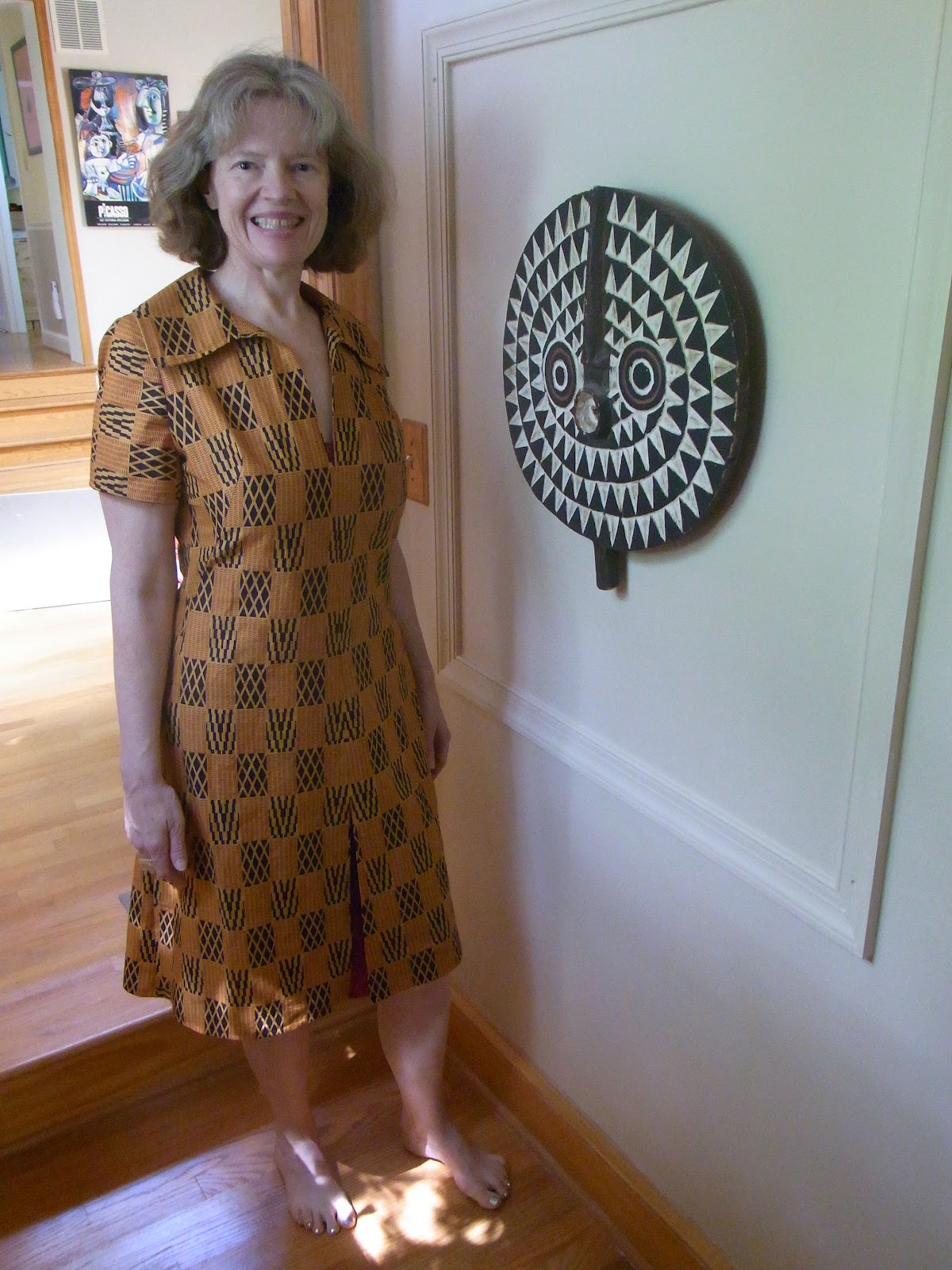
McCall's free pattern from Post Cereal; in W. African fabric

Here's the McCall's pounds-thinner pattern that my mom sent a while back.  I mentioned it in my last post, about vintage sewing patterns.  And I've made it up in some of the fabric I got in West Africa, probably Ghana or Burkina Faso.  It's supposed to look like strip-woven Kente (typical of Ghana); go to that page to see the real thing (strips woven on a narrow loom, then sewn together to form a delightful pattern).
The underside of the collar.

This is fairly cheap cotton, very thin & not at all drapy, and I was worrying about wearing it without a slip.  Then I remembered I had a pretty burgundy silk slip from Wintersilks, which almost matched the terracotta red in the cotton.  When I tried on the dress, almost done, yesterday, I had to take off 2.5" from the slip.  So I did that, and re-hemmed the slip.

Almost nothing left over!
I ended up using all that extra silk, though, because I barely had enough fabric to make the dress and there is nothing left over. I had to cut the length of the dress from selvage to selvage; there wasn't enough to cut it the normal way!  (Which meant I couldn't play with the length & proportions much--I just had the fabric width.)

I used the silk I cut off to hem the bottom & the sleeves.  There was so little fabric, I couldn't get the underside of the collar out of the kente print and had to use other West African wax print fabric.

Take it to the selvage!
I really made an effort to show the selvage of the fabric because we noticed that a lot in West Africa.  Rather than hemming, clothes are cut so the selvage is the hem.  However, this dress has quite a curved hem, so I ended up losing more than I wanted.

I will make this one again.  I love its cool look and big collar.  I will definitely add a bit in the middle so that the french darts are lower, and I'd probably make the overall length a bit longer, too.  Also, it needs a sway back adjustment (not much)...


BTW, it's got to be the best looking zipper I've ever installed!  I'll give a shout-out to Allison @ Bits of Thread in DC for her expert tutelage. 

Saturday, February 4, 2012

A D I N K R A ! - Fabric stamping from Ghana

I've mentioned before how we collect not only textiles, but also tools used to make those textiles.  So here are some Adinkra stamps along with a piece of Adinkra, all of which we got in Ghana. (Our travel photos from that trip are here.)  And here's a video of someone using the stamps.

The stamps are carved from calabash gourds & you can see on the 2nd example that they are curved.  You'll notice in the video that the printers have to "rock" the stamps a bit to get the complete design to stamp.

A piece of fabric uses many different stamps, broken up by the colorful embroidery used to stitch 2 strips of fabric together (again, strip woven fabric used as part of the overall design), then they use a piece of wood that looks like a hair pick to make the parallel lines that also make the outline of the checkerboard.

The stamps represent ideas and proverbs.  Head on over to adinkra.org to see an explanation of what the different symbols mean.  (Click on the symbols at the top of that page.) Photos of a stamp carver hard at work are here.
In the second photo, I was trying to show you how the stamps are held.  Each one has little holes in the back (3 or 4, depending on the size/shape of the stamp).  Small sticks are inserted into these holes (they look like overgrown toothpicks).  Then the 3-4 sticks are held together with a piece of cloth bound by string.  It is not at all stable, everything slips apart quite easily.  We try to never handle ours because they dismantle if you look sideways at them! We took them all apart to get them home, but have tried to avoid that since.

We bought our stamps at a tourist shop in Tamale and they haven't been used.

Thursday, September 22, 2011

From the Collection: Weaving Accoutrement, Part I

In addition to collecting textiles, we collect items used to make textiles (especially if they're wooden!).  I'll start off with items needed for weaving...drop spindles, shuttles & today, a back-strap loom and some loom pieces from Asia & Africa.

One reason we are drawn to such items is that besides being utilitarian, they are often beautifully decorated, too. They don't need to be carved in different shapes or have any decoration, but they do.  A great example is this loom (left) from Bobo Dioulasso, which has the hanging portion carved in the shape of a bird; I suspect this is from the Senoufo/Senufo people.  As a birder, I found a hornbill loom impossible to resist.

Bondouko
We're always amazed at how just a few bits of wood and string, if properly constructed can become a complicated loom.  We've seen them all over being used to make beautiful and intricate fabric.

In Africa the looms we saw weren't portable.  However, in Laos and Latin America you often see weavers using backstrap looms--all you need is a tree or fencepost and your loom is ready.

Here's a video of a man weaving in Cote d'Ivoire, on a loom much like this one. These looms are quite narrow (the resulting fabric is often about 6-7" wide, but some are even narrower).

Woven strip - Ghana
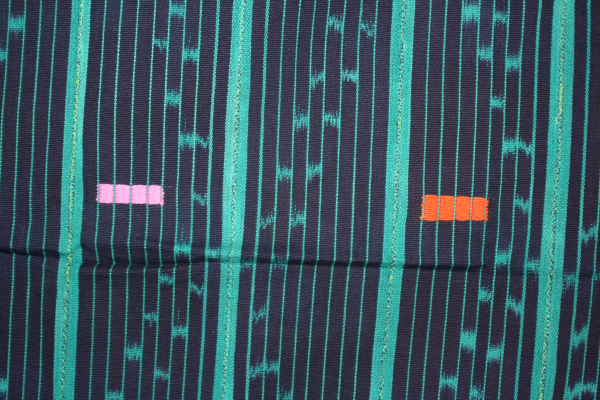
So what do you do with a very long piece of fabric that's only 6" wide? In West Africa, after strip-weaving, they sew all the narrow strips together, to great effect.  I believe this first example, blue & green (above), is some Bondouko cloth.  We bought this and another piece in Abidjan.  It has an interesting strip woven effect, but is also embroidered--unusual on a strip woven piece.  Embroidery is common, but on another type of fabric:  that made with Adinkra, or stamps carved from gourds. In the video, the man is making plain white fabric--this is useful, too, especially for printing on with mud to make Bogolon or mudcloth (you'll have to wait to see our examples of that).  

Left, above:  A strip we bought, basically just to show where Kente comes from.  These strips, however, are sold all over Ghana as souvenirs.  I can't imagine buying a strip, but not an actual piece of Kente; but that's just me.

Below are some examples of Kente & Ewe, from Ghana, where geometric design & strip weaving come together to create true masterpieces. This first one is cotton & rayon (I think).  Nowadays these items are worn for special occasions (we saw a few men in the villages wearing them, not often; perhaps they were officials, or on their way to a ceremony).  To give you an idea of how this cloth is worn, here is an amazing photo of three Fante women, two wearing Kente, the standing woman wearing an Adinkra print, taken in the late 1890s.   Strip weaving is a long process and requires a good eye and lots of work--these women were wearing their finest clothing, I suspect.

This blue & white fabric (left) is Ewe, also from Ghana.  The Ashante, who make Kente tend to use a wide variety of bright colors, while the Ewe tend to stick to indigo & white, with a healthy dose of primary colors to keep things interesting!  I am pretty sure we only saw Ewe made of cotton.


Finally, to the right is a silk Kente, which we bought in Tamale, in the north of Ghana.  Tamale is where you have to go if you want to get to Mole National Park; highly recommended.  It's also where I broke down in tears when I found a market selling used English-language paperbacks!  A story for another time--which would have been averted if Kindles or iPads were available then...

Remember I was talking about a simple-looking bit of wood & string put together to make a loom?  What comes off these looms is amazing.  Here's a piece we bought in northern Laos, at a "weaving village" mentioned in Lonely Planet.  We walked a few miles from where we were staying and found about 10-12 women using a variety of looms to create many different items.  We went for the largest piece they had, which you can see to the left.   (I have photos of that village, somewhere, but they'll have to be scanned in after I find them; this trip was in 2000.)

Back to the looms themselves:  reeds look much like a comb and are used to pack the weaving tightly.  (In the hornbill loom, above, the reed is the brown wooden part.)  Here are two combs from Laos.  The top is just the comb, while the bottom is the backstrap loom, complete with a bit of fabric and 4 heddles.  (Heddles are what makes the pattern.)  You'll probably notice the pleasing shape of these; all of these have been used as decoration in our various abodes because they are so lovely.

Here's a blog about backstrap weaving (an extremely portable loom).

If you're wondering, the carpet under these reeds is from Aswan in southern Egypt.  It's wool and another example of strip weaving, but with strips about 12" wide.  It's yet another masterpiece we've been lucky enough to come across (and afford).  More on carpets some other time.

I'd love your comments; are you bored stiff?  Should I go back to sewing?


Tuesday, July 5, 2011

Other stuff I've made: Quilts

West African Fabric Shop
I'm always raving about West African textiles & the roommate's & my 5-week shopping trip there...here are some quilts to show you what I made.  I bought a lot of fabric, and haven't made much of a dent in it, so plan to use more for dresses, shirts for the roommate, etc...

The first quilt (they are smallish 6' x 4' or so each) is called West African Fabric shop and shows nice orderly rows of fabric, one each of every kind I bought!  A friend in Dubai machine-quilted them for me.

The Anarchy of the African Market
The second quilt is titled The Anarchy of the African Market.  We like markets and find that they are a good place to observe the local people just being people, not selling things to tourists, or performing in any way.  We like to walk around a good market for a long time.  But the markets in Africa are pretty chaotic, to say the least, and really, downright scary.  (This doesn't include the much smaller, much harder-to-get-to markets of Goram Goram, Burkina Faso, or in Bahir Dar, Ethiopia, which were fun, friendly, not crowded and very interesting--though not if you were looking for tourist treasure.)  So this 2nd quilt tries to reflect that anarchy and explains why I ended up not buying much fabric at the markets!  And mostly why we skedaddled after 20-30 minutes...we did try to go a few times, in Ouagadougou, in Accra, in Lame, and in Tamale, in northern Ghana, but never lasted a half hour--scary!  Jammed so tight you knew you were a target for robbery (I get nervous about this anywhere in the world), and also, it was pretty easy to lose each other!  Yikes.

This last one is a table cloth, and it sort of quilted itself, because as I sewed each strip on, I sewed it to the backing, then I just put the binding on.  Hope you like seeing these.  Comments? Questions?

Here's a mix of classic highlife music to get you in the mood.  I'd recommend looking for a classic highlife (50s-60s) CD online, or at the library, to get a better taste of this amazing music.

Monday, July 4, 2011

African fabrics & crafts catching on in the fashion world!

You heard it here first!  So, my fascination with African fabrics is catching on, according to an article in the Washington Post on June 30.  I'm such a trendsetter.  If you check out the slide show associated with the article, picture 11 is my favorite: a lovely stack of fabric--super duper yummy.

Speaking of yummy stacks of fabric, here's a picture we took in Ghana in 2006 at a bus station.  We were fascinated by how everyone could carry stuff (big stuff!) on their heads, so took the photo to show that--but of course I love the fabric, too...I bought 80 lbs there.  If you'd like to see more of our photos from that trip, they are here...and thank you Reocities for reviving our once-dead Geocities site.  Here's an article about carrying stuff on your head & its efficiency (or not).

The roommate thought of this song:  Goin' Out of My Head, by Little Anthony & the Imperials.

Saturday, July 2, 2011

MMJ - West African skirt - I leaked into July

MMJuners, please forgive me.  I'll stop w/ the Mohammed-Made-June stuff, though there's quite a bit more in my closet.  But I do love this skirt.  It looks like Adinkra, which is stamped fabric made in Ghana, though this is batik, not stamped. (BTW, that video is great and even includes the symbol on my skirt.)  The symbols have meaning, and you see a large variety all over Ghana, on fabric, artwork, decorating stores, buses, labels in the grocery store--everywhere.  Anyway, the Gye Name symbol (on my skirt it's the non-square symbol) means the "supremacy of God."

Wearing this skirt is always a great opportunity to get out my green/turquoise sandals, my turquoise sunglasses and my turquoise (as opposed to green) turquoise.

Friday, June 24, 2011

BTW, concerts such as Youssou n'Dour are great for checking out amazing African textiles (mostly West African prints & bogolan). The audience really dresses up & it's fun to see the mix of traditional and modern styles.  To give you an idea, the quilt pictured here is made from the 80 lbs of printed fabric & woven textiles we brought back from our trip there. Another fun aspect is the audience is not shy about dancing!  Although the music is so amazing, I don't think many people could stand still.