Sunday, September 25, 2011

From the Collection: Weaving Accoutrement Part II

Shuttles!  What's a shuttle?!  A shuttle carries the thread being woven back & forth (much like the shuttle that carries me back & forth between work & the Metro station).  In this video from Laos, you can see the weaver swapping between different shuttles to change the color & create a pattern.  BTW, this was filmed near Luang Prabang, Laos, which is where we bought the fabric I showed on the previous post.  You'll notice that the reeds on the looms are much like the ones we have, too.  And look at these looms--they are just wood & string, but they make magic!

So back to shuttles--aren't they gorgeous?!  I love the different styles & shapes & the well-seasoned wood.  The two darkest shuttles are from Laos (again, they're featured in the video).  The two on the left are from the Czech Republic.

Remember in the previous post I wrote that a loom is just a contraption made of sticks and string?!  But the sophistication of this arrangement & the sophistication of the fabric that comes out of these looms never ceases to amaze me.  Here's a fine example of a shawl from Indonesia.  I suspect that's the monkey king featured in the design.

I do go on, don't I?!  Some more Ghanaian textiles to the right...we took this at a shop in Accra.  The wall is full of mostly Kente cloth, but also some Ewe cloth & plain woven items.  The Ewe and Kente tend to be strip-woven, but now they have wider looms in Ghana, too, so that explains the less intricate patterns.  I think we came home with seven Kente and 3 Ewe, plus quite a bit of other stuff, too, like masks and miniature coffins (see here for an explanation of why we needed a coffin model).  However, our motto is We should have bought more!  

Friday, September 23, 2011

Charade - a favorite movie & my dream clothes

I wanted to respond to Tilly's post about films & inspiration for sewing (or shopping).  The Roommate & I have many movies we love & I can watch them over & over.  One we watch together, probably once a year or so is Charade, which for me has everything anyone could ever want in a life:  Audrey Hepburn's body, clothes by Givenchy, Cary Grant to fall in love with, a mystery, an amazing apartment and Paris in English.  So I did a search & found some amazing Givenchy clothes, modeled by Ms. Hepburn...

Here she is walking near Notre Dame.  I love the suit--sort of Chanel-y!  I might even consider the hat.  

 Can you see the darts on this dress?  Interesting using the thick fabric, which I think may be stretchy--so it looks like a sweater but fits nicely.  I have a feeling that belt wouldn't go around one of my thighs!  

 Another gorgeous coat.  I could also stand to have someone style my hair every morning as I can only stand to spend 5-10 minutes on it. The soft shoulders and the collar seem so ladylike.  

 I could not find a picture of her in this amazing cocktail outfit (top & skirt) which I love & would wear every day if I owned it.  I had to get this photo from Christies website, where it fetched $US 303K in 2006.  

Many of the outfits in the movie are matching dresses & coats--and they are all great.  Look at the boatneck!  And the way the coat is cut. 


Best of all, it's a great movie, too, with lots of plot twists & turns and amazing scenery.

I keep forgetting to add music, but here's the Theme from Charade.  Actually, it's the trailer; go check it out!

Thursday, September 22, 2011

From the Collection: Weaving Accoutrement, Part I

In addition to collecting textiles, we collect items used to make textiles (especially if they're wooden!).  I'll start off with items needed for weaving...drop spindles, shuttles & today, a back-strap loom and some loom pieces from Asia & Africa.

One reason we are drawn to such items is that besides being utilitarian, they are often beautifully decorated, too. They don't need to be carved in different shapes or have any decoration, but they do.  A great example is this loom (left) from Bobo Dioulasso, which has the hanging portion carved in the shape of a bird; I suspect this is from the Senoufo/Senufo people.  As a birder, I found a hornbill loom impossible to resist.

Bondouko
We're always amazed at how just a few bits of wood and string, if properly constructed can become a complicated loom.  We've seen them all over being used to make beautiful and intricate fabric.

In Africa the looms we saw weren't portable.  However, in Laos and Latin America you often see weavers using backstrap looms--all you need is a tree or fencepost and your loom is ready.

Here's a video of a man weaving in Cote d'Ivoire, on a loom much like this one. These looms are quite narrow (the resulting fabric is often about 6-7" wide, but some are even narrower).

Woven strip - Ghana
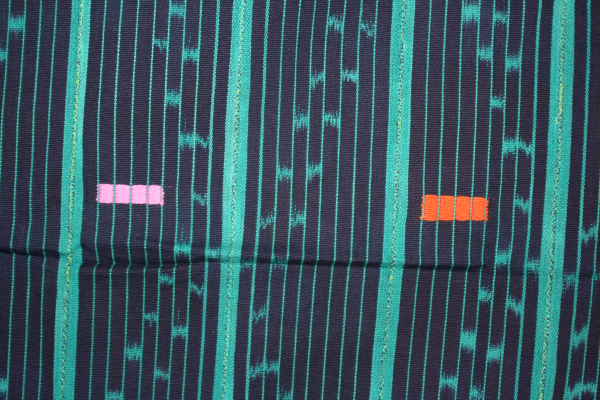
So what do you do with a very long piece of fabric that's only 6" wide? In West Africa, after strip-weaving, they sew all the narrow strips together, to great effect.  I believe this first example, blue & green (above), is some Bondouko cloth.  We bought this and another piece in Abidjan.  It has an interesting strip woven effect, but is also embroidered--unusual on a strip woven piece.  Embroidery is common, but on another type of fabric:  that made with Adinkra, or stamps carved from gourds. In the video, the man is making plain white fabric--this is useful, too, especially for printing on with mud to make Bogolon or mudcloth (you'll have to wait to see our examples of that).  

Left, above:  A strip we bought, basically just to show where Kente comes from.  These strips, however, are sold all over Ghana as souvenirs.  I can't imagine buying a strip, but not an actual piece of Kente; but that's just me.

Below are some examples of Kente & Ewe, from Ghana, where geometric design & strip weaving come together to create true masterpieces. This first one is cotton & rayon (I think).  Nowadays these items are worn for special occasions (we saw a few men in the villages wearing them, not often; perhaps they were officials, or on their way to a ceremony).  To give you an idea of how this cloth is worn, here is an amazing photo of three Fante women, two wearing Kente, the standing woman wearing an Adinkra print, taken in the late 1890s.   Strip weaving is a long process and requires a good eye and lots of work--these women were wearing their finest clothing, I suspect.

This blue & white fabric (left) is Ewe, also from Ghana.  The Ashante, who make Kente tend to use a wide variety of bright colors, while the Ewe tend to stick to indigo & white, with a healthy dose of primary colors to keep things interesting!  I am pretty sure we only saw Ewe made of cotton.


Finally, to the right is a silk Kente, which we bought in Tamale, in the north of Ghana.  Tamale is where you have to go if you want to get to Mole National Park; highly recommended.  It's also where I broke down in tears when I found a market selling used English-language paperbacks!  A story for another time--which would have been averted if Kindles or iPads were available then...

Remember I was talking about a simple-looking bit of wood & string put together to make a loom?  What comes off these looms is amazing.  Here's a piece we bought in northern Laos, at a "weaving village" mentioned in Lonely Planet.  We walked a few miles from where we were staying and found about 10-12 women using a variety of looms to create many different items.  We went for the largest piece they had, which you can see to the left.   (I have photos of that village, somewhere, but they'll have to be scanned in after I find them; this trip was in 2000.)

Back to the looms themselves:  reeds look much like a comb and are used to pack the weaving tightly.  (In the hornbill loom, above, the reed is the brown wooden part.)  Here are two combs from Laos.  The top is just the comb, while the bottom is the backstrap loom, complete with a bit of fabric and 4 heddles.  (Heddles are what makes the pattern.)  You'll probably notice the pleasing shape of these; all of these have been used as decoration in our various abodes because they are so lovely.

Here's a blog about backstrap weaving (an extremely portable loom).

If you're wondering, the carpet under these reeds is from Aswan in southern Egypt.  It's wool and another example of strip weaving, but with strips about 12" wide.  It's yet another masterpiece we've been lucky enough to come across (and afford).  More on carpets some other time.

I'd love your comments; are you bored stiff?  Should I go back to sewing?


Tuesday, September 20, 2011

More Molas!


I realized last night that I'd forgotten to post some other molas we bought recently at an exhibit at the Quilt Museum in San Jose, CA.  I like these because a) they're great and b) we know pretty surely how old they are (maybe!).

Saturday, September 17, 2011

From the Collection: Molas!

The Kuna, native Americans who live on the San Blas Islands off the coast of Colombia (but are part of Panama), are artists.  Textile artists, in fact, doing some of the most amazing & difficult handwork I can think of...reverse applique.  I don't even like applique, much less reverse.  So I thought I'd share with you some masterpieces collected by the Roommate's grandmother back in the 1960s and the item that got me thinking about this particular blog item, a gift from a Panamanian friend who lives in Abu Dhabi, but spent some time in her home country this past summer and sent me a beautiful present that she knew I'd love (she was correct!).

It is believed that molas (literally "clothing" or "dress") originated as body painting for the Kuna.  When Europeans brought fabric, thread, needles & scissors (and Christian morals), the artistry was transferred to material and the women began wearing their creations.  BTW, the Kuna are a matrilinear society; land transfers from mother to daughter & a husband moves in to live with his wife and her family after the marriage.

Though we have been to Panama, we haven't been out to the San Blas Islands (disfortunamente!), so our two oldest and most authentic molas were collected by Marc's grandmother back in the 1960s.  However, no one knows where she got them; she did make a trip to Central America, but we don't know where she picked these two up.  You can see in the detail photos the variety of color and layers that go into one of these pieces.  They are hand sewn (tiny stitches) and I am pretty sure they didn't use iron-on stabilizer so the cut fabric didn't unravel!  ;-)

I know you'll want to see what the women who make these look like, and how they wear them.  I borrowed some pictures from Casa Coqui's blog.  The molas are sort of like a bodice, then sleeves and the upper portion of the top are added on, usually in plain fabric.

I love their elaborate leggings & arm coverings--they are beads, but are patterned to look like their intricate geometric molas!  Take a look at the leggings this woman has on--at first glance they look like they are fabric, too.  I think coming up with a beaded design like this must be at least as difficult as reverse applique!!

If you want to find out more, check out these websites:
The Mola Museum
Wikipedia's Mola page
Sherry Thorup's How to Make a Mola

You can read more in Karin Tice's book from 1995, Kuna Crafts, Gender and the Global Economy.

Finally, here's a photo of the gift my friend sent me from Panama.  It's a cosmetic bag & you can see why just about everything in Panama seems to have a mola on it now:  it's bright, geometric & can be any size or shape.

Let me know if you try out the reverse applique technique--and send me photos, too, please!

Thursday, September 15, 2011

From the Collection: For use with camels

Take a look at these items.  Any guesses as to what they are?  Here's a hint: if you had a camel, rather than a subway, train or car, you might need these.  First of all, the round baskets are camel milk baskets!

These baskets, with a leather covering, are useful for milking your camel; before plastic became ubiquitous, leather was great for transporting milk.  We got these when we lived in Oman & they are made by the Bedu, some of whom are still nomadic. (Really the term is transhumance:  they move from the desert in the winter to the seashore in the summer.  When we were living there from 1998 - 2002, we had students, at the university, who had been raised that way until they went away to boarding school; their families back "home" still moved around every 6 months or so.)

And the Tuareg camel bags are for transporting goods--much prettier than our suitcases.  They are also leather & are decorated lavishly. Fringe, colored embroidery, paint & detailed leather work.  We bought these in northern Burkina Faso at a market in Goram Goram.

Check out Tribal Music for more Tuareg items.  I especially like the rings!  Wow.  We didn't see much jewelry for sale in Goram Goram...it's really a market for the locals, not the tourists, so it was mostly farming goods, food, a bit of clothing and camels, of course!

The Roommate & I love markets; we like to see what it's like to go shopping elsewhere.  We are just as amused in a grocery store in the UK or Japan as we are in a market in Bahar Dar, Ethiopia, or northern Burkina Faso.  What are the people buying and selling, what do they wear to the market? (In Oman, certainly, the women really dress up.)  If you only see your friends 3-4 times each month, you'd dress up, too!

We have been trying to get the new house decorated.  Part of that involves treating it like a museum--we have boxes, most labeled in the basement, and we try to switch out our stuff so we can enjoy it all...hope you enjoy seeing all this, too!

Monday, September 12, 2011

Another twisted pinwheel square

Thought you'd like to see another one of the quilt blocks for the wall-hanging I'm working on.  I think this one is nice & contrasty.  I'm getting the roommate's opinion on all the versions I make now...

It's not sewed together in this photo, but it is done now & I'm working on another...

Once I got the basic idea down, it comes together quite quickly, without the gadget or even a pattern.